
Claude Pricing 2026: is Pro or Max actually worth it?(Cost & Value)
I hit the rate limit three times last Tuesday. Mid-task, every time. The first time it was annoying. By the third time I'd closed the tab and opened something else. If you've used the free tier for anything beyond casual Q&A, you know this feeling. The daily cap on messages isn't a gentle nudge, it's a brick wall — and it's the main reason people start Googling "claude pricing."
This article is what I wish I'd read before upgrading. I've spent way too much time digging through pricing pages, Reddit threads, and benchmark data to figure out which tier actually makes sense. Here's what I found.
How Claude pricing works in 2026 (and why it's built this way)
Anthropic runs a tiered subscription model, same general idea as Spotify or Notion. Free gets you in the door. Pro is where things get useful. Max is where you pay for elbow room.
The logic is pretty simple: AI compute burns GPU hours, and models like Opus cost a lot more to run than Sonnet. If they charged one flat rate, it'd either scare off casual users or lose money on power users. Tiers let them align cost with how much you actually use the thing.
Here's how claude pricing breaks down in practice:
- Free — subsidized access with daily message caps. Enough to kick the tires, not enough to build a workflow around it.
- Pro ($20/month) — 5× the free tier's capacity, priority speed, and access to the full model family including Opus.
- Max ($100 to $200/month) — 5× or 20× Pro's usage ceiling. Higher output limits, early feature access, best availability during peak traffic.
The thing that matters most: moving up doesn't unlock new features (except Claude Code, which needs Pro or above). You're paying for capacity and speed, not shiny new buttons. If you're not hitting Pro's limits, Max is just an expensive way to have the same experience.
One more thing worth knowing: annual billing drops Pro to $17/month ($204/year), about 15% off. Max doesn't have an annual discount as of June 2026, per Anthropic's pricing page.
Claude plans and pricing: Free, Pro, and Max
Here's the current claude pricing lineup, checked against Anthropic's official page as of June 2026:
| Plan | Monthly | Annual | Who it's for |
|---|---|---|---|
| Free | $0 | $0 | Trying things out, light use |
| Pro | $20/mo | $17/mo ($204/yr) | Daily work, developers, writers |
| Max 5× | $100/mo | $100/mo | People who keep hitting Pro ceilings |
| Max 20× | $200/mo | $200/mo | Heavy coding sessions, high-volume output |
Free: what $0 actually gets you
The free plan isn't a trial that expires. It's a real, permanent tier. You get Sonnet 4.5 as the default, plus web search, memory, code execution, and MCP connectors. Works on web, iOS, Android, and desktop.
No credit card, no expiration.
The catch is that daily message cap, around 15 to 20 messages depending on demand. During weekday peak hours you'll run into it, often mid-conversation, and wait 30 to 60 seconds between responses. If you use AI a few times a day for quick questions, it's fine. If you're trying to get actual work done, it starts feeling like the engine cuts out every time you hit the gas.
I used Free for about two months before I cracked. The moment I needed Opus for a coding problem and couldn't access it — that was the tipping point.
Pro: the $20/month tier where things get real
Pro is where the tool stops being an occasional helper and becomes something you actually rely on. For $20/month (or $17/month annual), here's what changes:
- 5× the free plan's usage. Enough for 80 to 100+ messages a day.
- Full model access: Sonnet 4.5 plus Opus 4.6, Anthropic's flagship reasoning model.
- Priority speed. No queueing during peak hours. Responses in 3 to 8 seconds.
- Claude Code, the terminal-based coding tool that runs in your IDE.
- Unlimited Projects with persistent memory across sessions.
- Extended thinking for multi-step problems that need deeper reasoning.
- Claude Cowork for desktop automation, Slack and Google Workspace integration.
The math works out to about $0.02 per interaction if you're a heavy user (30 to 40 messages a day). Hard to beat at that price.
Max: $100 to $200/month for breathing room
Max is Pro with a capacity multiplier. You get two options:
5× Pro at $100/month, or 20× Pro at $200/month.
That's it. Same features, same models, just more room before you hit a wall. It's built for two very specific kinds of user: developers who run Claude Code for hours at a stretch, and content folks producing high volumes every day.
If you wrap up most days on Pro without seeing a rate limit warning, Max adds exactly zero value for you. Reading through r/ClaudeAI, the consensus is pretty clear: Pro covers 90% of paid users just fine.
Claude Free vs Pro vs Max: the differences that actually matter
Here's all three tiers side by side. This is where claude pricing stops being abstract:
| What you get | Free | Pro | Max |
|---|---|---|---|
| Price | $0 | $20/mo ($17/yr) | $100–$200/mo |
| Default model | Sonnet 4.5 | Sonnet 4.5 + Opus 4.6 | Sonnet 4.5 + Opus 4.6 |
| Daily messages | ~15–20 | ~80–100+ | 5× or 20× Pro |
| Peak speed | 30–60 sec, queueing | 3–8 sec, no queue | Fastest |
| Claude Code | No | Yes | Yes |
| Projects | No | Yes (unlimited) | Yes (unlimited) |
| Extended thinking | No | Yes | Yes |
| Research mode | No | Yes | Yes |
| Output length | Standard | Standard | Higher |
| Early features | No | No | Yes |
| MCP connectors | Yes | Yes | Yes |
| Web search | Yes | Yes | Yes |
| 200K context | Yes | Yes | Yes |
Where the value actually breaks
The Free to Pro jump is massive. You go from something that sometimes works to something that always works, and you get Opus. That's the single biggest value leap in the whole claude pricing structure.
A Reddit developer described Opus as "the most tasteful coder" they've ever used. That's not a small compliment from a dev community.
The Pro to Max jump is different. It's a capacity decision, not a capability decision. You don't get new tools — you get more room to use the ones you already have. The 5× or 20× multiplier only matters if Pro's ceiling is what's slowing you down. For most users, spending 5× or 10× more on claude pricing for that extra headroom doesn't make sense.
What people actually say
Scrolling through Reddit, a few patterns stand out:
Free users keep talking about message caps. It's not a minor complaint — it comes up constantly, especially during weekday working hours. The frustration feels real, not theoretical.
Pro users are mostly happy. The upgrade removes the two biggest pain points (limits and queueing) and throws in tools that actually do something useful.
Max users are a narrow group. Developers in long coding sessions, content machines churning high volumes, that sort of thing. Everyone else calls it overkill.
One Reddit story that stuck with me: someone was debugging a React app with Opus. It didn't just find the memory leaks — it explained why they mattered and gave working fixes. That's the kind of depth you're paying for on Pro.
The gripes are pretty consistent too: no image generation, moderation that sometimes errs on the cautious side, and rate limits that can still hit Pro users under heavy load.
Is Claude Pro worth it in 2026?
Let me be direct about who benefits and who doesn't.
Pro is worth it for:
Developers and programmers — strongest case by far. If you write code every day, Claude Code alone covers the $20. Layer on Opus scoring 67.60% on SWE-bench (ahead of GPT-5 at 65.00%), and you've got something that beats ChatGPT Plus for coding workflows. I've watched devs on Reddit describe Opus as having a "taste" for architecture and refactoring that other models just don't.
Writers and content people — here's where I have personal experience. The output reads less "AI-smelly" than ChatGPT, more like something a human would actually write. When you're producing articles or reports regularly, having no daily cap means you can actually think through things instead of counting messages. A content creator on G2 put it well: Pro turned the assistant from something they occasionally asked for help into a core part of how they work.
Researchers and analysts — 200K context plus Projects with persistent memory means you can dump research papers, legal docs, or financial reports in and keep context across sessions. Free can't do that at any real volume.
Pro probably isn't worth it for:
Casual users — under 5 sessions a day, mostly simple questions. Free handles that. The $20 saves you from occasional rate limits, but that's not much value for 10 minutes of use.
Image-heavy workflows — no image generation, period. If you need DALL-E style output, ChatGPT Plus has that covered at the same price.
Python data analysis — ChatGPT's code interpreter is better for running scripts and visualizing data. Pro can write the code, but it doesn't have the same sandboxed execution.
The numbers, honestly
- Heavy user (30+ interactions a day): about $0.02 per interaction. The time you save from no interruptions plus Opus access easily beats $20.
- Moderate user (10 to 20 a day): depends on how complex your work is. Multi-step reasoning, long documents — Pro pays. Mostly simple Q&A — it's a coin toss.
- Light user (under 10 a day): stay Free. Claude pricing doesn't reward you at this volume.
How to get the best value from Claude
Before you hand over full price, here are a few ways to spend less or get more.
Go annual
Pro drops to $17/month on annual billing ($204/year). That's 15% less than monthly. If you know you'll use it for a year, it's the easiest saving available. Annual plans bill upfront and aren't refundable after Anthropic's cancellation window, so be sure.
Use the API for batch work
If what you're doing is mostly document analysis, code generation, or data extraction (not interactive chat), the API's 50% batch discount undercuts a Pro subscription. Haiku 4.5 costs $1 per million input tokens and $5 per million output with batch pricing. For structured, non-interactive tasks, that's meaningfully cheaper than $20/month.
Prompt caching saves even more — cache reads are only 10% of standard input pricing. If you're feeding the same context repeatedly (codebase, document library), that adds up.
Mix Free and Pro
You don't need Pro for every query. Use Free for quick questions and save Pro for the complex stuff that needs Opus or longer sessions. Not elegant, but it works.
Claude Pro vs ChatGPT Plus
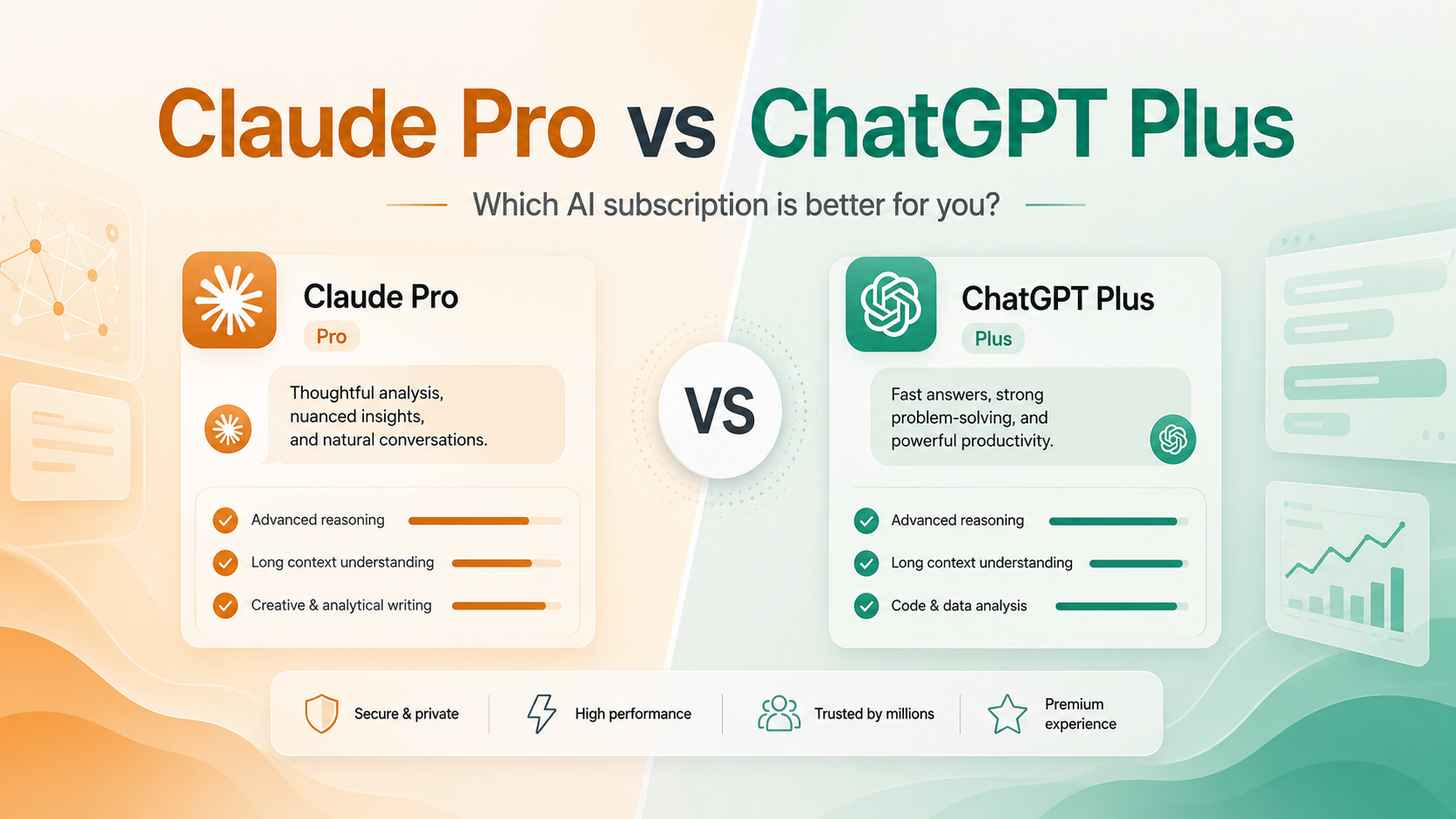 Both cost $20/month, but they give you different things:
| Pro ($20/mo) | ChatGPT Plus ($20/mo) | |
|---|---|---|
| Coding tool | Claude Code | Separate subscription |
| Desktop automation | Cowork | No |
| Context window | 200K tokens | 128K tokens |
| Projects | Unlimited | Limited |
| Image generation | No | DALL-E |
| Annual discount | $17/mo | $20/mo (none) |
If you code or write, Pro wins. If you need images plus search plus code execution in one place, ChatGPT Plus is broader.
Can't pay directly? Here's a workaround
Anthropic's payment system is picky about regions and card types. If you're outside their supported countries, you'll probably hit 3DS verification failures, billing address mismatches, or just flat-out rejection. This is a well-documented headache for cross-border AI subscriptions.
I've been pointing people to FamilyPro for this. They do Claude Pro top-ups at $24.99/month for a private account. The process: grab your Organization ID from account settings, paste it on their order page, and the top-up usually finishes within minutes. They have a 24-hour response window for support and a refund warranty if your access gets unexpectedly downgraded (assuming it's not from a personal account issue). The private account setup means you keep your own identity, Projects, and history — you're not sharing credentials with strangers. 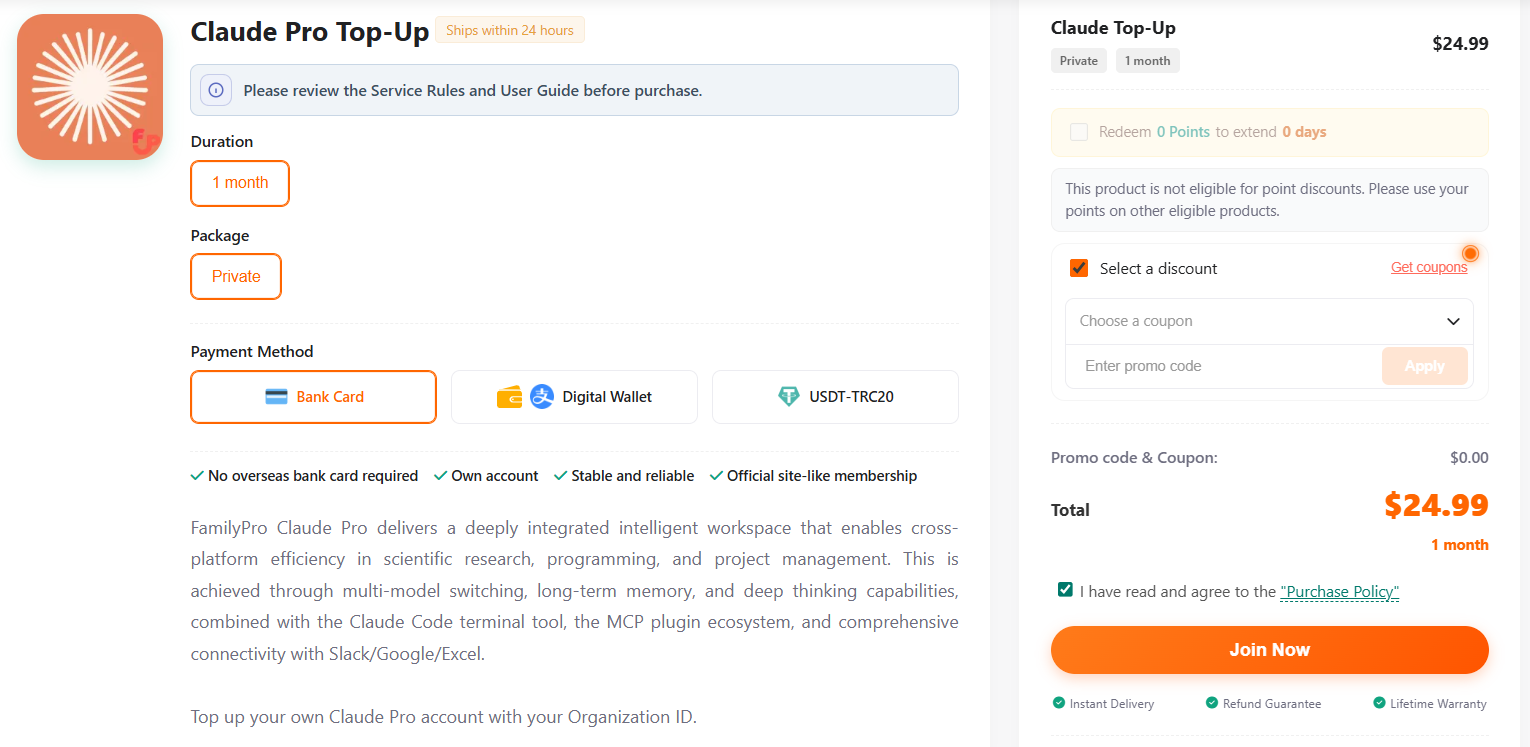
Check for education and open-source programs
Anthropic has institution-level education plans and has given API credits to open-source maintainers. If you're a student at a partner institution or maintain a qualifying project, check Anthropic's education page — Pro-level access at reduced or zero cost is sometimes available.
FAQ
Is Claude free? Yes. $0, no credit card. You get Sonnet 4.5, web search, memory, code execution, and MCP connectors. Daily message limit is roughly 15 to 20.
How much does Claude Pro cost? $20/month (monthly billing) or $17/month ($204/year) on annual. That claude pricing tier includes 5× Free usage, Opus, Claude Code, Projects, and priority speed.
What's Claude Max? Two tiers: 5× at $100/month and 20× at $200/month. Same features as Pro, just more capacity plus higher output limits and early feature access. Built for developers running hours of Claude Code or professionals doing high-volume work. Most Pro users don't need it.
Can I cancel anytime? Monthly subscriptions, yes — cancel before the next billing cycle. Annual plans bill upfront and aren't refundable after the cancellation window.
Student discount? Institution-wide educational plans exist. Individual student discounts aren't publicly listed on the standard claude pricing page. Check with your institution or Anthropic's education programs.
Cheaper than ChatGPT? Both are $20/month at the individual level. Pro has an annual discount ($17/month) that ChatGPT Plus doesn't offer. At the team level, Team Standard runs $20/seat/month annual while ChatGPT Business is $25/user/month.
Which plan for a solo professional? Pro at $20/month ($17 annual) covers almost everyone. Max only if you're actually exhausting Pro's limits regularly, which most people aren't.
Can I use Claude Code on Free? No. Claude Code needs Pro or Max. That's one of the clearest dividing lines in claude pricing — terminal-based AI coding needs at least the Pro tier.
What if I hit Pro's limits? Pro has a lot more headroom (5× Free) but it's not infinite. Under extreme load or heavy extended thinking, Pro users can still see temporary slowdowns. Max gets priority over Pro during peak congestion.
API pricing vs subscriptions? The API bills per million tokens separately. Haiku 4.5: $1/MTok input, $5/MTok output. Sonnet 4.6: $3/MTok input, $15/MTok output. Opus 4.8: $5/MTok input, $25/MTok output. Batch API is 50% off. For non-interactive batch work, the API can be cheaper than a Pro subscription.
Final verdict: which plan should you pick?
After all the research, benchmark digging, and Reddit scrolling, claude pricing in 2026 comes down to a few straightforward calls:
Stay on Free if you use the tool under 5 times a day, mostly for simple stuff, and you can live with occasional rate limits. The $0 tier is genuinely usable — it's not a crippled demo.
Go Pro if you hit it more than 5 times daily, you're doing complex work (coding, writing, research, analysis), or Free's limits keep breaking your flow. At $17 to $20/month, this is where claude pricing delivers the best value by a wide margin. For developers, writers, and researchers, Pro earns its keep.
Look at Max only if you're constantly running into Pro's ceiling — that's developers in long coding sessions or content professionals doing heavy daily output. Max doesn't give you new capabilities. It gives you room. At $100 to $200/month, that room needs to be worth it.
If payment access is your bottleneck, the official subscription path can be a non-starter depending on where you live. FamilyPro's top-up service is a reliable fallback — $21.99/month, private account, keeps your own identity and Projects intact.
The short version: Pro at $17 to $20/month is the sweet spot. Start there. Move to Max only if Pro's limits are actually in your way. And if paying directly doesn't work from your region, you've got options.
Last updated: June 18, 2026. Pricing checked against Anthropic's official pricing page.