
Free Mobile App Competitor Analysis Tools: A Practical 2026 Guide
Start app competitor research with public store listings, rankings and reviews, then add a specialist tool for the question those sources cannot answer. Free access, a free starter plan and a trial that becomes paid are different. None gives you a competitor's audited finances. This guide compares seven options by task and access conditions, without unsupported accuracy scores or a “best overall” ranking.
Contents
- Seven options and what free access means
- Define a comparison you can actually use
- Use Appark to build a shortlist
- Interpret estimates without confusing them with facts
- Turn the audit into a weekly decision
- Frequently asked questions
Seven options and what free access means
| Option | Useful for | Access boundary to check |
|---|---|---|
| Appark | Charts, discovery and estimated download/revenue trends | Free access is advertised; exact countries, history, exports and quotas require checking |
| Sensor Tower | Public top-chart comparisons | Visible rankings do not establish free access to detailed estimates |
| MobileAction | ASO keyword and competitor research | ASO offers a 7-day trial; its separate free Apple Ads product is not the same entitlement |
| AppTweak | A time-limited ASO audit | 7-day trial, business email and billing details; paid subscription begins unless cancelled |
| Similarweb extension | Competitors' website traffic context | Free website estimates, not proof of app installs or in-app retention |
| Appfigures | App analytics and ASO workflows | Free Starter is advertised; competitor intelligence and history depend on the selected plan |
| App Store Connect benchmarks | Comparing your eligible app with peers | Requires authorized app access; anonymized groups, not named rivals' private results |
MobileAction's trial also requires billing information and can convert to a paid subscription. Check the exact offer, billing interval, cancellation deadline and what remains accessible after expiry before starting any trial. A landing page saying “start free” does not prove unlimited reports, all markets or permanent historical access.
Define a comparison you can actually use
Choose one store, country, category and date range. Record each app's store ID, publisher and business model so that a similarly named app does not contaminate the comparison. Select three direct competitors solving the same user problem; a small photo editor and a global social network are rarely useful financial peers.
Use a research sheet with these columns: app ID, market, period, source, metric definition, observed or estimated value, missing data, next action. Record a blank estimate as “unavailable,” not zero. For a first audit, collect screenshots, listed prices, recent release notes and a manageable sample of recent reviews from the same period.
Use Appark to build a shortlist
Appark is retained as a featured example from FamilyPro's original article; that placement is not an independently tested superiority claim. Its advanced search can help narrow the market. Begin with store, region and a relevant category or keyword, then use release date or estimate filters where your account permits them. Check current plan access before assuming a screenshot's features are free.
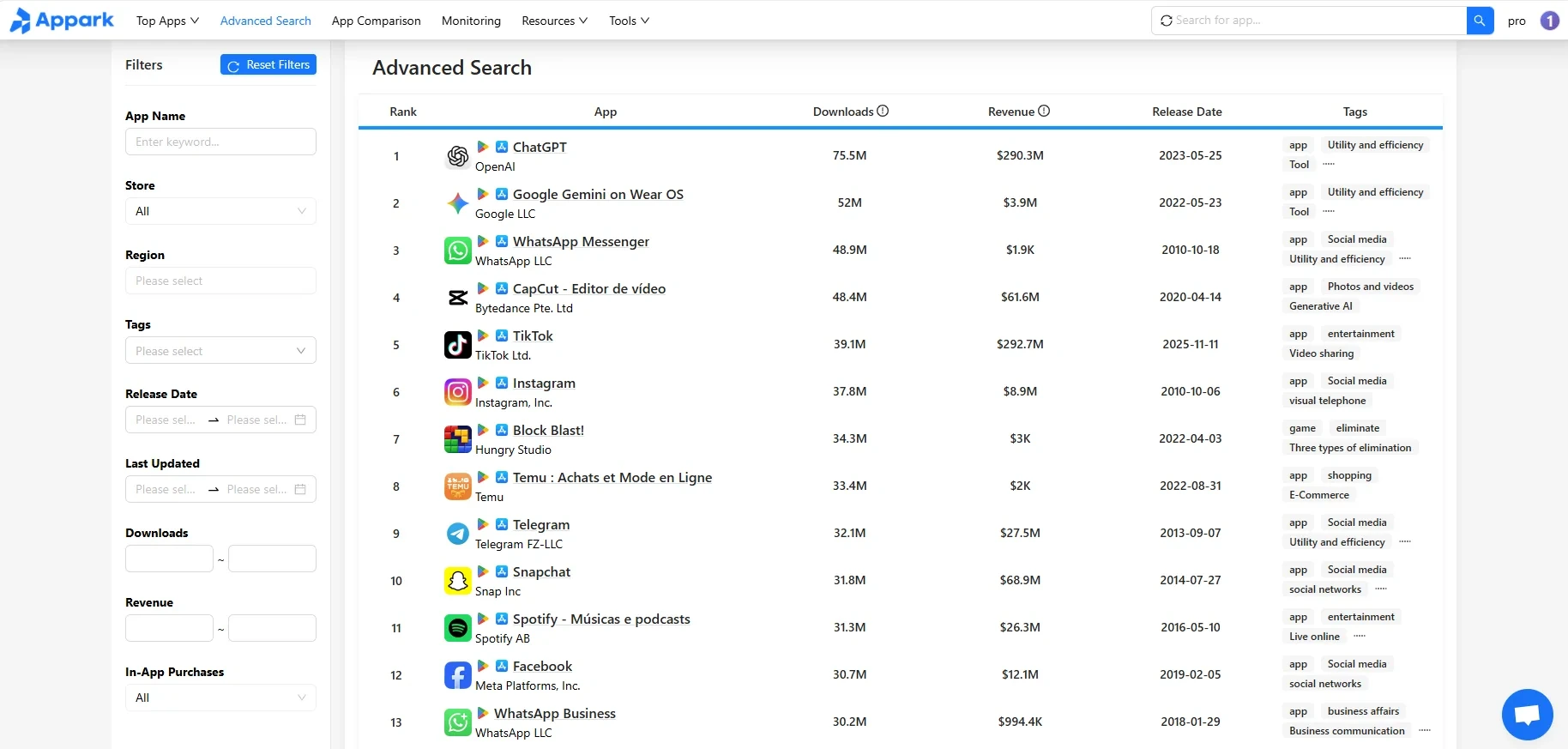
The original screenshot shows a Pro label. Its figures illustrate an interface, not verified current revenue, and do not prove what a free account can view. Confirm the app IDs and the estimates' period before saving a candidate. Use an estimated revenue band as a shortlist filter, not as evidence that an app has a viable or profitable business.
Interpret estimates without confusing them with facts
Rank is ordinal: moving from 20 to 10 does not prove downloads doubled. A revenue estimate may cover store purchases while excluding advertising or web subscriptions; confirm gross versus net, refunds, currency, store and country coverage. Revenue also is not profit: acquisition, platform fees, staff and infrastructure costs matter.
Compare like-for-like periods within one provider first, then cross-check direction against another independent signal. A new screenshot followed by higher ranking is correlation, not proof that the screenshot caused growth. Pre-order visibility indicates a forthcoming listing, not established demand or guaranteed sales.
Translate evidence into a bounded experiment. For example, if several recent reviews mention confusing onboarding, test clearer instructions in your own app and measure completion rate. Do not copy a rival's keyword merely because it appears in a title; verify relevance to your actual features and test conversion as well as visibility.
Turn the audit into a weekly decision
Pick one product improvement, one store-page experiment and one metric to monitor. Save the baseline, change one major variable at a time and record release dates. Revisit the same apps and market each week rather than repeatedly collecting unrelated screenshots.
Pay for a tool only when it unlocks a specific missing decision input, such as longer keyword history or an export you will regularly use. Compare coverage, refresh frequency, definitions and cancellation terms before price. An expensive estimate is still an estimate; a free chart can be sufficient for an initial shortlist.
Frequently asked questions
Can I learn a competitor's exact revenue for free?
Not from a third-party estimate alone. Public company disclosures may provide financial facts, but often at a company or segment level rather than one app and country. Keep reported data separate from modeled numbers.
Are official developer consoles competitor research tools?
They primarily describe your own authorized apps. Peer benchmarks show anonymized aggregate comparisons, not a competitor's customer list or financial account. Use them to diagnose your own performance.
Which option should I start with on a zero budget?
Begin with store pages, reviews and accessible charts. Add free website context only when the competitor has a relevant web business. Use trials for a defined audit with a cancellation plan, not as a permanent free-data strategy.