
Gemini 4 Neon vs Gemini 4 Carbon: Which Should You Use?
Based on the currently available pricing and benchmark information, the choice between Gemini 4 Neon and Gemini 4 Carbon depends on your task type, reasoning requirements, and actual usage. Available results come from different testing conditions, so neither model should be treated as universally better without a controlled, like-for-like comparison.
What Are Gemini 4 Neon and Gemini 4 Carbon?
Gemini 4 Neon is the fourth Gemini 4 model Google has shipped in roughly five weeks, made generally available on November 18, 2026. Google positions it between Hydrogen and Carbon for high-frequency complex tasks, with fast end-to-end completion across software engineering, knowledge work, and science workflows. Third-party writeups of the model card add a useful detail: Neon was derived from Carbon and refined in post-training with a focus on coding agents. We cover Neon's own rollout in more depth in our Gemini 4 Neon guide.
Gemini 4 Carbon arrived earlier in the fall, announced in late October 2026 and opened to developers in early November. Google positions it as its strongest model for security engineering and long-horizon tasks that can run for days, and launch coverage from third parties put it at the top of the Artificial Analysis Intelligence Index at release. How Carbon stacks up against Argon and the paid API tiers is its own comparison; our breakdown of Gemini 4 Carbon vs the Argon, Pro, and Ultra API tiers covers that pairing.
Google positions Carbon for the hardest long-horizon tasks, Neon for frequent complex work, and Hydrogen for quick everyday requests. Google
Gemini 4 Neon vs Gemini 4 Carbon Pricing
Any Gemini 4 Neon vs Gemini 4 Carbon pricing comparison is really a comparison of dates, because Carbon sits on a dated rate card and Neon does not. Here are the API token prices for Gemini 4 Neon vs Gemini 4 Carbon at the standard tier:
| Model | Input, per 1M tokens | Output, per 1M tokens | Scheduled change |
|---|---|---|---|
| Gemini 4 Carbon | $2.00 through Nov 30, 2026; $4.00 from Dec 1, 2026 | $10.00 through Nov 30, 2026; $20.00 from Dec 1, 2026 | Yes, rates double |
| Gemini 4 Neon | $3.00 | $15.00 | None announced |
Standard paid rates are in USD. On December 1, cached input for Carbon rises from $0.10 to $0.20 per million tokens. Neon costs $0.15 per million cached input tokens. Rates checked November 27, 2026. Gemini Developer API
Thinking tokens are billed at the output rate, which matters for reasoning-heavy prompts. These prices describe the Gemini Developer API only; Google AI subscriptions price access differently and are covered in the access section below.
The short version: through November 30, Carbon is the cheaper frontier option on paper. From December 1, Neon costs about 25% less on both input and output, and it is the only frontier-tier Gemini without a posted increase.
Performance, Quality, and Speed: Is Neon Really Carbon-Level?
Most takes on Gemini 4 Neon vs Gemini 4 Carbon lean on a popular narrative: Neon gives you Carbon-level quality for less. The evidence partly supports that and partly does not, and the difference usually comes down to which test, which reasoning tier, and which date you are looking at.
Reasoning and Complex Tasks
Neon and Carbon both score 60 at high reasoning on the Artificial Analysis Intelligence Index. Neon scored 61 at xhigh in its launch evaluation. The reasoning setting and benchmark version matter when comparing scores. Artificial Analysis
Coding Performance
Google reported Carbon scores of 88.2% on SEC-bench Pro, 54.8% on ExploitGym, and 71.0% on Collinear CWE-bench. Google
In Artificial Analysis’s coding-agent evaluation with Antigravity CLI, Neon (xhigh) scored 59 and Carbon (high) scored 55. Artificial Analysis
Long-Context Handling
Both models have a shared context window of 1,048,576 tokens and a default synchronous output limit of 65,536. For long-document work, give both models the same material and check whether their answers cite it accurately. Neon · Carbon
Speed and Latency
In the Artificial Analysis launch evaluation, Neon (xhigh) generated about 110 output tokens per second versus about 57 for Carbon (high) and finished benchmark tasks about 40% faster. Actual latency depends on the task, reasoning setting, and output length. Artificial Analysis
Real Cost: Three Ways to Measure, Three Different Answers
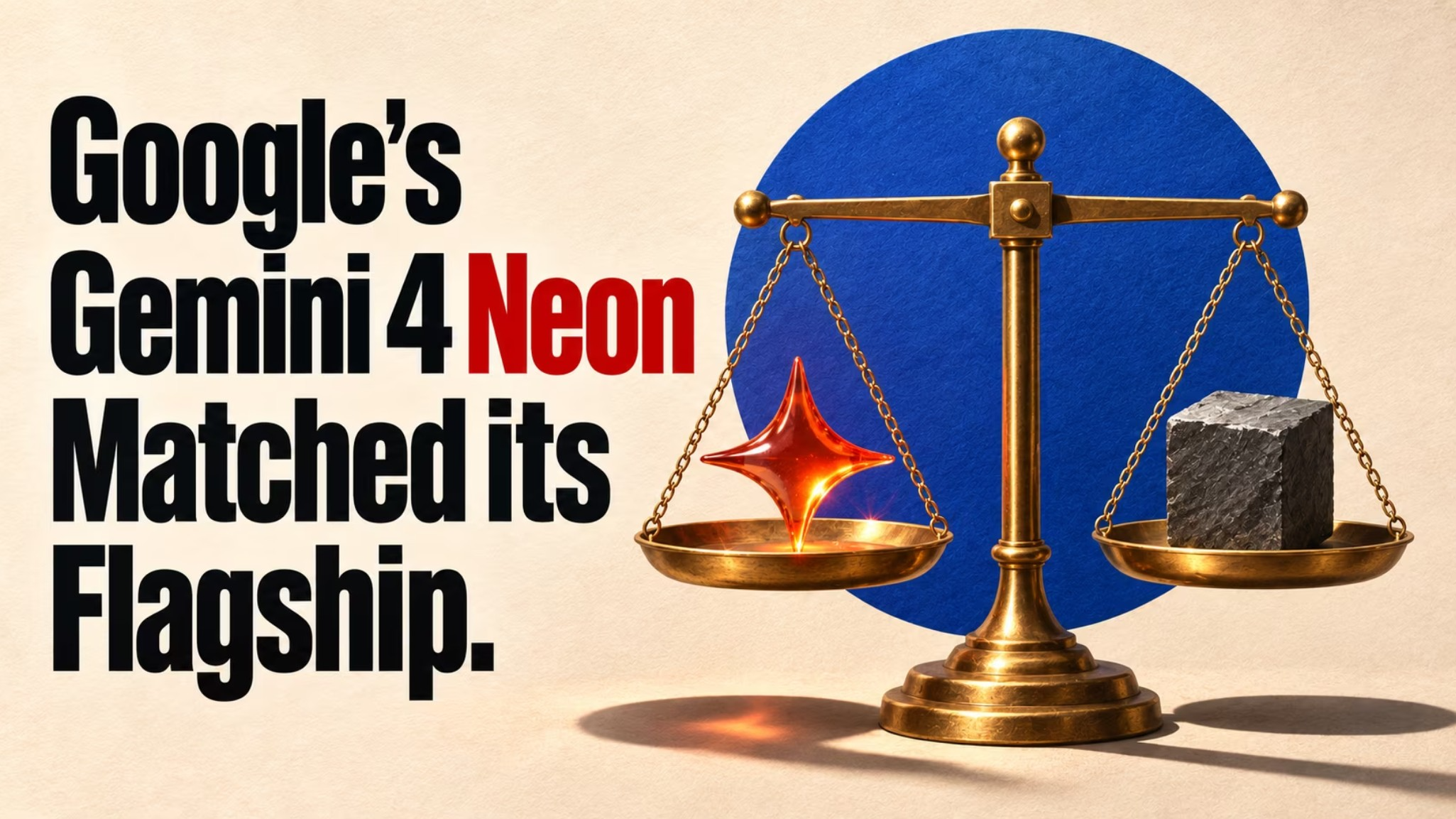
A Gemini 4 Neon vs Gemini 4 Carbon cost comparison produces three different answers, because cost means three different things depending on how you measure it. None of the three is wrong; each answers a different question and each has limits.
| Measure | What it captures | Published numbers | What it misses |
|---|---|---|---|
| Token cost | Price of the input and output tokens you send | See the pricing table above | Thinking-token differences, cache pricing, task shape |
| Cost per task | Average cost to complete one benchmark task end to end | Artificial Analysis (high): Neon $3.74, Carbon $7.76 | Carbon cost uses non-discounted pricing |
| Cost per sample | Cost of one run on a specific task | Measure on your own sample | A single run may not represent your workload |
One worked example, labeled as an estimate: suppose a month of API usage covers 10 million input tokens and 2 million output tokens. On Neon that is (10 x $3.00) + (2 x $15.00) = $60. On Carbon it is (10 x $2.00) + (2 x $10.00) = $40 through November 30, and (10 x $4.00) + (2 x $20.00) = $80 from December 1. Your real bill also depends on how many thinking tokens each model burns and whether you use caching, so treat this as arithmetic, not a quote.
Which measure should you trust? The one that matches your workload. If you run the same kind of task all day, cost per task is the closest proxy, provided the benchmark's tasks resemble yours. If your usage swings from week to week, log the usage fields your API console already reports for one week and compute your own blend; our guide to Gemini usage limits explains how thinking tiers change that mix.
No ranking claim lives in this section: none of these measures makes either model cheaper in general, and mixing numbers from different test conditions produces figures that look precise but mean nothing.
Which Should You Use? Decision Guide by Scenario
The Gemini 4 Neon vs Gemini 4 Carbon decision looks different depending on what you run. The table splits the choice by scenario and gives reasons based only on evidence that exists.
| Scenario | Better fit today | Why | Watch out for |
|---|---|---|---|
| General daily use | Probably neither; Hydrogen is the everyday tier | Simple prompts rarely need frontier reasoning, and Hydrogen runs $1.50/$7.50 | Both protagonists cost more per token than Hydrogen |
| High-frequency coding agents | Neon, if your tasks resemble the agent benchmarks | Third-party task-cost and speed data favors it, and its price is stable | Those tests are not head-to-head runs on your workload |
| Security-critical or long-horizon engineering | Carbon | Its security benchmarks are the only published evidence in this niche | Those numbers come from Google's own launch testing |
| Long-context, complex reasoning | Too close to call | High-tier reasoning scores sit near parity across different runs | No controlled comparison exists yet |
| High-volume API workloads | Likely Neon | Its flat $3/$15 pricing gives it lower published token rates than Carbon from December 1, with no announced increase | The cost-per-task evidence has known limits; confirm the rate card and model your own usage first |
| Cost-sensitive workloads | Depends on the date | Carbon's introductory price is cheapest through November 30; Neon is cheapest after | The intro price ends; do not budget on it lasting |
If you use Gemini through a Google AI plan rather than the API, model access works differently, and the next section covers what each plan includes as far as anyone can currently verify.
How to Get Gemini 4 Neon and Carbon
API access. Get a key at ai.google.dev and pay per token at the rates in the pricing table above. This is the only route where the $2/$10 to $4/$20 change and Neon's flat $3/$15 apply directly.
Google AI subscriptions. Google confirms that Neon is available in the Gemini app for Google AI Pro and Ultra subscribers, while Carbon is available to Ultra subscribers. Neon · Carbon
A subscription buys you quota inside Gemini's apps and tools. It is not unlimited API usage, and the token prices above do not transfer to it.
Gemini 4 Neon vs Gemini 4 Carbon: FAQ
What is the difference between Gemini 4 Neon and Gemini 4 Carbon? Carbon is the heaviest Gemini 4 model, built for deep reasoning, security engineering, and multi-day tasks. Neon was derived from Carbon and tuned for complex tasks that finish fast and run often. On price, Carbon's rate card doubles on December 1, 2026, while Neon stays at a flat $3/$15.
Is Neon cheaper than Carbon? Carbon has lower standard API token rates through November 30. From December 1, Neon is about 25% cheaper per token. In Artificial Analysis’s high-setting benchmark, Neon averaged $3.74 per task versus $7.76 for Carbon at its non-discounted rate.
Which is better for coding? Both are credible. Carbon has the only published security-specific numbers; Neon shows better speed and cost on third-party agent benchmarks. No controlled head-to-head exists, so test both on your own tasks.
Can I access Neon or Carbon through Google AI Pro? Google AI Pro gives you access to Neon in the Gemini app. Carbon requires Google AI Ultra.
Is Carbon's introductory price ending on December 1? Yes. Standard API input and output rates rise from $2/$10 to $4/$20 per million tokens on December 1, 2026. Cached input rises to $0.20 per million tokens on the same date. Gemini Developer API