
Is GPT-5.6 Free? 2026 Access, Pricing & 72% Cheaper
You heard GPT-5.6 dropped. You searched "GPT-5.6 free" and landed here. The question is simple, the answer is not.
I get it. I've watched these rollouts since GPT-4o dropped in 2024 — every time OpenAI ships something, the search bar fills with "is [model] free." With GPT-5.6, the three-model lineup that dropped June 26, 2026, the answer is more complicated than a simple yes or no, and having gone through the GPT-5 and GPT-5.5 release cycles, I can tell you the pattern matters more than the press release.
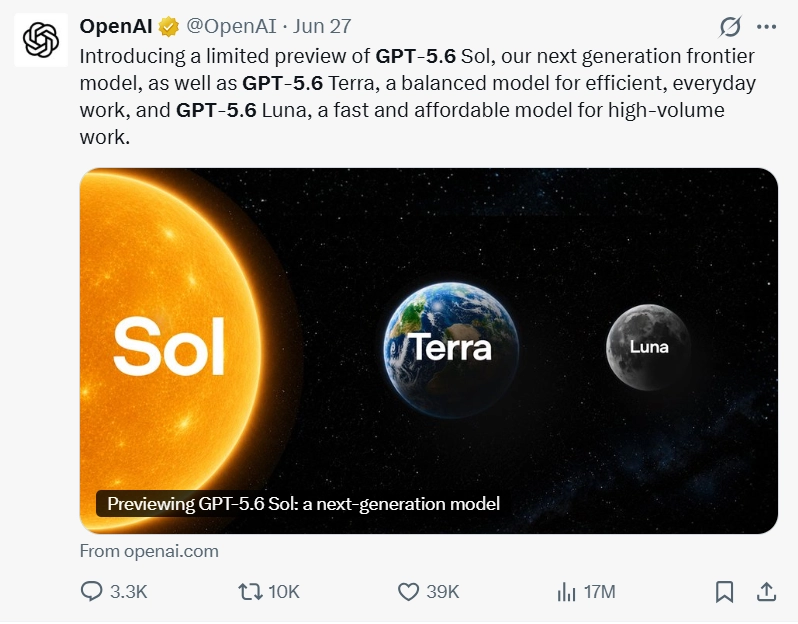 Here's the frustrating part: GPT-5.6 is objectively the most powerful AI model OpenAI has ever built. It crushes Anthropic's Claude Mythos 5 on coding benchmarks. It introduces an "ultra" mode that spawns sub-agents to break complex tasks apart. And yet, you can't use it right now, free or paid. The "GPT-5.6 free" access you're hoping for doesn't exist yet. Only about 20 government-approved organizations have access.
That's the reality as of late June 2026. But the story is going to change fast, and this article breaks down exactly what happens next, what you'll actually pay, and one way to get GPT-5.6 free access for about 72% less than what most people will spend.
Is GPT-5.6 Free? Short Answer: Not Yet for Most Users
No, GPT-5.6 is not free yet for regular users. As of June 2026, roughly 20 organizations — vetted and approved by the US government — can access the models through OpenAI's API and Codex. If you searched "GPT-5.6 free" hoping to try Sol, Terra, or Luna without paying, that's not possible yet. No ChatGPT plan (Free, Plus, or Pro) includes GPT-5.6 right now.
But that "yet" matters. OpenAI announced GPT-5.6 as a limited preview, not a permanent paywall. In their official June 26 blog post, they wrote:
"We plan to make them more broadly available to people using ChatGPT, Codex, and the API soon."
They also added something that tells you how they really feel about the restricted rollout:
"We don't believe this kind of government access process should become the long-term default. It keeps the best tools from users, developers, enterprises, cyber defenders, and global partners who need them."
So the question isn't really "is GPT-5.6 free?" It's "when will GPT-5.6 free access become available, and how much will I pay for the useful tiers?"
GPT-5.6 Free Access: Who Can Access It Now & How to Get In
Who Has Access Right Now
OpenAI released GPT-5.6 on June 26, 2026 as three models: Sol (flagship), Terra (balanced), and Luna (fast/cheap). But instead of a public launch, they limited access to a small group of "trusted partners." Specifically, organizations that underwent a multi-agency review involving the White House Office of the National Cyber Director, the Office of Science and Technology Policy, and the Department of Commerce.
Why? The Trump administration's June 2 AI executive order created a voluntary review process for frontier models. For GPT-5.6, that "voluntary" process became mandatory. As TechCrunch reported, Commerce Secretary Howard Lutnick warned Sam Altman that GPT-5.6 could not ship until multiple agencies signed off — not just Commerce.
This matters to you because it means GPT-5.6 free access is being treated differently than any previous OpenAI release. There's no public waitlist, no "apply for access" button. The ~20 organizations that got in were hand-picked and individually vetted.
How to Actually Get Access (4 Options)
| Method | Difficulty | Cost | Who It's For |
|---|---|---|---|
| Wait for GA (general availability) | Easy | Free to $200/mo depending on plan | Most people |
| API limited preview application | Medium | Per-token pricing | Developers |
| Join an approved organization | Very hard | — | Researchers |
| Get ChatGPT Plus now, be first in line when Terra drops | Easy | $5.5/mo via FamilyPro, $20/mo official | Everyday users who want Terra |
The GA timeline from OpenAI is "in the coming weeks." Realistically, based on their track record with GPT-5.5's rollout, that means mid-to-late July 2026. There's also an August 1 deadline imposed by Congress for the Commerce Department to respond to the AI safety review framework — watch that date as a potential milestone.
Will GPT-5.6 Be Free in ChatGPT? (Free Tier Predictions)
OpenAI hasn't announced exact ChatGPT tiers for GPT-5.6 yet. But based on three straight releases — GPT-4o (2024), GPT-5 (2025), GPT-5.5 (April 2026) — the pattern is locked in. So locked in, in fact, that multiple analysts treat it as a given. Each release has answered the same "GPT-5.6 free" question differently for different models, and the underlying logic hasn't changed.
Sam Altman's own framing tells you most of what you need to know. In the June 26 announcement, he wrote: "We believe in broad access, and we plan to make GPT‑5.6 Sol, Terra, and Luna generally available in the coming weeks." "Broad access" isn't "everyone pays $200" — it means a tiered rollout where the cheapest models flow to free, and the serious compute stays behind the paywall.
Zvi Mowshowitz, who runs the widely-read AI strategy newsletter Don't Worry About the Vase, flagged something in his GPT-5.6 system card analysis that's easy to miss: the staggered release isn't random. "Altman says we are looking at 'a few weeks' before the general rollout," Mowshowitz noted, timing his own full capabilities report for "several days after general release." The implication: when that general release hits, it won't be a single "GPT-5.6 is live for everyone" button. It'll land in waves, following the same free-then-Plus-then-Pro unlock sequence OpenAI has used since 2024.
So where does each model land? Here's what the pattern — combined with the economics — strongly suggests:
Luna → Free Tier
Personally, if GPT-5.6 launches in ChatGPT exactly the way GPT-5.5 and GPT-4o did, I expect Luna to become the free model first. That has been OpenAI's pattern for the past several releases: the cheapest new model lands on free, the workhorse hits Plus, the flagship stays behind Pro.
Luna is OpenAI's cheapest model ever at $1 input / $6 output per 1M tokens. That's not an accident — when a model costs pennies to serve, putting it on the free tier keeps casual users in the ecosystem and competes directly with Google's free Gemini and Anthropic's Claude free plan. I've watched OpenAI play this exact chess move three times now. The economics haven't changed.
If you're searching "GPT-5.6 free" hoping to try the model without paying, Luna on the free tier is the answer. But expect message caps. After testing GPT-4o free and GPT-5.5 Instant free across different times of day, the pattern is consistent: free users get roughly 15–20 messages every 3 hours with noticeable slowdowns during US business hours. Luna will almost certainly follow the same cap structure.
Terra → Plus ($20/mo)
Terra is where things get interesting — and where most people reading this should actually land. It roughly matches GPT-5.5's performance at half the API cost ($2.50/$15 per 1M tokens). That makes it the obvious Plus-tier model: good enough for real work, cheap enough for OpenAI to include in a $20/month plan without bleeding money. Every release since GPT-4 has placed the "balanced workhorse" on Plus. Terra follows that logic cleanly.
From my experience using GPT-5.5 through Plus across writing, coding, research, and light data analysis, the Plus-tier model is the real daily driver. Not the flagship, not the free model. The balanced one. I'll go into why this matters more than most people think later, but the short version: if you actually use AI for work, Terra on Plus is the rational default. Sol is for something specific.
Sol → Pro ($200/mo)
Sol is the flagship, with ultra multi-agent mode and max reasoning. Its API pricing ($5/$30 per 1M tokens) gives you a signal: this is an expensive model to run. OpenAI doesn't give away expensive compute. Pro at $200/month has always been the home for models with these economics.
Here's the thing about Sol that most coverage misses: the benchmarks are incredible, but the use cases where Sol actually meaningfully outperforms Terra are narrow. I tested a bunch of GPT-5 vs GPT-5.5 Pro comparisons when 5.5 dropped, and the gap between "best Plus model" and "Pro flagship" narrowed significantly. If GPT-5.6 free tier access follows the same trajectory — and the system card suggests it does — Sol's edge over Terra matters mainly for multi-hour agentic coding sessions, vulnerability research, and the kind of work where "slightly better reasoning" compounds across hundreds of turns. For most people, it won't.
What Free Users Probably Won't Get
If you're on the free tier when GPT-5.6 lands, here's the stuff that'll almost certainly be gated behind Plus or Pro:
- Ultra mode — the sub-agent system that spawns multiple worker agents for complex tasks
- Max reasoning — the deepest reasoning toggle for hard problems
- Priority access during peak hours (free users get deprioritized when the servers are busy)
- Codex Computer Use — the feature that lets the model actually operate your computer
- Full context window — if the leaked 1.5M token window materializes at GA, free users will get a fraction of it
Data source note: The 1.5 million context window is widely reported across multiple outlets including ic.work and developer trackers, but OpenAI hasn't confirmed it in their official documentation. Treat it as unverified until the GA announcement.
GPT-5.6 Free vs Paid: Which ChatGPT Plan Includes It
Here's the comparison you're actually looking for if you searched "GPT-5.6 free" — which model lands where, once GPT-5.6 hits ChatGPT. Note that "GPT-5.6 free" in practice means something specific: Luna on the zero-dollar tier, not the flagship models.
Current State (June 2026 — Limited Preview)
| ChatGPT Plan | Monthly Cost | GPT-5.6 Sol | GPT-5.6 Terra | GPT-5.6 Luna | What You Actually Get Now |
|---|---|---|---|---|---|
| Free | $0 | ❌ | ❌ | ❌ | GPT-5.5 Instant (lightweight free model) |
| Plus | $20/mo | ❌ | ❌ | ❌ | GPT-5.5, Codex, file uploads, deep research |
| Pro | $200/mo | ❌ | ❌ | ❌ | GPT-5.5 Pro, unlimited usage, priority |
Predicted GA State (Expected July-August 2026)
| ChatGPT Plan | GPT-5.6 Sol | GPT-5.6 Terra | GPT-5.6 Luna | Official Price | FamilyPro Price |
|---|---|---|---|---|---|
| Free | ❌ | ❌ | ✅ (with limits) | $0 | — |
| Plus | ❌ | ✅ + Luna | ✅ | $20/mo | $5.5/mo |
| Pro | ✅ + Ultra + Max | ✅ | ✅ | $200/mo | — |
Here's my honest take after testing these tiers across multiple release cycles: Plus is the sweet spot, and it's not close. You get Terra (balanced, actually useful for daily work) and Luna (fast, free-tier quality when you need quick answers) for $20/mo, or way less if you use a shared plan.
Free is tempting because it's free. But I've found that Luna-level models on the free tier work for maybe 40% of what I actually do — the other 60% needs the reasoning depth that only Terra-tier models provide. Free is fine for "summarize this article" or "draft a quick email." It falls apart when you need to debug code across three files, research a complex topic, or write something that doesn't sound generic.
Pro at $200/mo only makes sense if Sol's specific advantages translate directly into your workflow. I'll break down exactly who that applies to — and who it doesn't — in the next section.
GPT-5.6 Pricing: What's Free & What Costs Extra
Let's get concrete about GPT-5.6 free vs paid pricing. Here's every price point you need to know, starting with what OpenAI has confirmed.
API Pricing (Developers)
These are the confirmed prices from the OpenAI preview announcement:
| Model | Input (per 1M tokens) | Output (per 1M tokens) | What This Means |
|---|---|---|---|
| Sol | $5 | $30 | 6× more expensive output than Luna. Pay this when you need the best. |
| Terra | $2.50 | $15 | Half the cost of Sol. For high-volume business and production workloads. |
| Luna | $1 | $6 | Our cheapest model ever. Fast everyday work at minimal cost. |
To put Sol's pricing in perspective: Anthropic's Claude Fable 5 costs $10 input / $50 output per 1M tokens. Sol is roughly half that for input and 40% less for output. This is aggressive pricing from OpenAI, directly aimed at making GPT-5.6 the default choice for developers running high-token workloads.
ChatGPT Subscription Pricing
| Plan | Monthly Cost | What You Get at GA | Best For |
|---|---|---|---|
| Free | $0 | Luna only (with message caps, no advanced features) | Casual users, occasional queries |
| Plus | $20/mo | Terra + Luna, Codex, file upload, deep research, priority access | Professionals, creators, power users |
| Pro | $200/mo | Sol + Terra + Luna + Ultra mode + Max reasoning + unlimited usage | Researchers, developers, heavy workloads |
Is Pro Worth $200? Depends Entirely on Your Workflow
For most people, no. But "most people" isn't everyone, and I want to be specific about where the line is, because I've made the mistake of overpaying for Pro when Plus would've been fine.
Here's what I've learned after comparing Plus-tier and Pro-tier models across GPT-5 and GPT-5.5: the gap between them shrinks with every generation. GPT-5 Pro felt meaningfully better than GPT-5 Plus — you noticed the difference. By GPT-5.5, the Plus-tier model was close enough that I stopped reaching for Pro unless I was doing something that genuinely needed the extra reasoning depth. GPT-5.6 free tier rollout looks like it continues that trend. Sol is better than Terra on paper, but in practice, Terra handles most real workflows without you ever feeling the ceiling.
Who should pay for Pro (Sol):
- Security researchers doing vulnerability analysis across large codebases. Sol's systematic multi-agent reasoning is built for this.
- Developers running multi-hour agentic coding sessions where small reasoning improvements compound across hundreds of turns.
- Scientists and researchers working on problems where the quality difference between "very good" and "best available" actually changes the output.
- People who max out Terra's context window and need the full 1.5M token context (assuming it materializes at GA).
Who should stick with Plus (Terra):
- Writers, marketers, content people — Terra handles drafting, editing, research, and analysis without breaking a sweat. Sol is overkill.
- Developers doing normal coding work — Terra's coding benchmarks match GPT-5.5's, which was already excellent. Unless you're doing the kind of work where "slightly better" compounds over hours, you won't notice the difference.
- Students and researchers doing typical academic work — literature review, summarization, analysis. Terra is more than enough.
- Anyone using AI as a thinking partner rather than a fully autonomous agent.
Who should stick with Free (Luna):
- Casual users who ask a few questions a day
- People who mainly summarize articles or draft short emails
- Anyone who just wants to try the model before committing to a paid plan
The real reason most coverage hypes Sol is that benchmarks make for clean comparison tables. But benchmarks don't capture what daily use actually feels like. I've used flagship and balanced models side by side, and for the work most people actually do — writing, research, analysis, coding help — the balanced model is indistinguishable from the flagship 95% of the time. Paying 10× more for the last 5% is only rational if that 5% is your entire job.
How to Use GPT-5.6 for Less
Here's the part where we talk about the gap between what things cost and what you should actually pay.
$20/mo Is the Sticker Price, Not the Real Price
ChatGPT Plus at $20/month gets you Terra — the model most people actually want. But $20/month adds up. That's $240 a year. If you're also paying for Claude, Perplexity, or other AI tools, you're stacking subscriptions.
OpenAI allows ChatGPT Plus to be shared through family plans — one subscription, multiple users. The official setup requires you to manage the sharing yourself: find people you trust, coordinate payments, handle renewals. It works, but it's friction. I tried organizing this manually with a few friends last year — we lasted two months before someone forgot to Venmo and the whole thing fell apart.
The Shared Plan Alternative for GPT-5.6 Free-to-Paid Fans
Subscription-sharing platforms take the hassle out of it. Here's how the math works:
| Method | Monthly Cost | Annual Cost | Savings |
|---|---|---|---|
| Official ChatGPT Plus | $20.00 | $240.00 | — |
| Shared plan (you organize) | ~$5–$7 | $60–$84 | 65–70% |
| FamilyPro shared plan | $5.50 | $66.00 | 72.5% |
FamilyPro handles the matching, payments, and renewals. You get the same ChatGPT Plus experience — GPT-5.5 today, GPT-5.6 Terra when it drops — at less than a third of the official price. If you're a student, this gets even better: FamilyPro's student pricing guide breaks down how students can stack savings to get Plus for as little as $5.5/month with none of the verification headaches that come with official student discounts.
Think about it this way: instead of paying $240/year for one Plus subscription, you could get Plus for $66/year and still have $174 left over for other tools. Or put differently: you pay for 3.5 months at the official rate, but you use it for 12 months on FamilyPro.
Why This Matters for GPT-5.6 Free Access in Practice
When GPT-5.6 free access opens up in ChatGPT, Plus users will be the first regular users to access Terra. Free users will get Luna only — useful, but not the model you've been reading about in benchmarks.
If you get a Plus plan now through FamilyPro at $5.5/month:
- You use GPT-5.5 today (still one of the strongest models available)
- You're first in line for GPT-5.6 Terra when it launches
- You lock in the lower rate before any potential price changes
👉 Get ChatGPT Plus for $5.5/month on FamilyPro — Access GPT-5.5 today, GPT-5.6 Terra when available.
FAQ
Is GPT-5.6 free?
GPT-5.6 is not free yet for most users. As of June 2026, GPT-5.6 free access is limited to about 20 government-approved organizations through API and Codex. OpenAI says a broader rollout, including ChatGPT, is coming in the "coming weeks." When the GPT-5.6 free tier opens up, Luna is expected to be the free model, Terra on Plus ($20/mo), and Sol on Pro ($200/mo).
When will GPT-5.6 be available in ChatGPT?
OpenAI has not confirmed a specific date. Their official language is "in the coming weeks." Based on previous rollout patterns (GPT-5.5 took about 3 weeks from preview to ChatGPT), expect mid-to-late July 2026, with August 1 as a hard deadline tied to the Congressional review timeline.
Which GPT-5.6 model will be free?
Luna is the most likely candidate for GPT-5.6 free tier access. It's OpenAI's cheapest model ever ($1 input / $6 output per 1M tokens), designed for fast, high-volume everyday tasks. Based on how GPT-4o and GPT-5.5 free tiers worked, GPT-5.6 free access should include Luna with message rate limits — probably 15-20 messages every 3 hours.
How much does GPT-5.6 cost?
API pricing: Sol $5/$30 per 1M tokens, Terra $2.50/$15, Luna $1/$6. ChatGPT pricing (expected at GA): Free tier gets Luna with limits, Plus ($20/mo) gets Terra + Luna, Pro ($200/mo) gets Sol + Terra + Luna + Ultra mode.
Can I get ChatGPT Plus cheaper than $20/month?
Yes. Subscription-sharing platforms like FamilyPro offer ChatGPT Plus for $5.5/month — roughly 72% cheaper than the official $20/month price. You get the full Plus experience (GPT-5.5 now, GPT-5.6 Terra when available) with no feature differences from the official plan.
What's the difference between Sol, Terra, and Luna?
Sol is the flagship — strongest at coding, cybersecurity, and agentic reasoning, with unique "ultra" and "max" modes. Terra is the balanced workhorse — roughly matches GPT-5.5 performance at half the API cost. Luna is the fast, cheap option for everyday tasks like summarization and drafting.
Is GPT-5.6 better than GPT-5.5?
Sol outperforms GPT-5.5 on all key benchmarks, especially coding (Terminal-Bench 2.1) and cybersecurity. Terra roughly matches GPT-5.5's performance at significantly lower cost. For everyday tasks, GPT-5.5 and Terra are in the same ballpark — but Terra costs half as much to run. If you're deciding between waiting for GPT-5.6 free tier or paying for GPT-5.5 now, the real question is whether Luna's limitations will bother you.
Do I need ChatGPT Pro for GPT-5.6?
Only if you need Sol with Ultra mode for multi-hour agentic coding sessions, deep security research, or scientific work. For writing, analysis, coding help, and everyday productivity, Terra on Plus is the practical choice — and at $5.5/month through FamilyPro, it's the clear value pick for anyone who asked "is GPT-5.6 free" and realized "free" means Luna with limits.
Conclusion: Is GPT-5.6 Free — The Bottom Line
GPT-5.6 is not free yet. It's not available on ChatGPT at all right now — only about 20 organizations have access, and they got in through a government-vetting process that OpenAI itself called "not the long-term default."
But here's what matters if you're looking for GPT-5.6 free access:
- Luna will be free with limits when GPT-5.6 free access hits ChatGPT (likely July 2026)
- Terra needs Plus ($20/mo), and it's the model most users will actually want
- Sol needs Pro ($200/mo), and it's overkill unless you're doing serious technical work
- FamilyPro gets you Plus for $5.5/mo — same access to GPT-5.6 Terra when it drops, 72% less
Here's how I'd play it if I were in your shoes, based on watching these rollouts since 2024: if you just want to try GPT-5.6 without paying, wait for Luna on the free tier. It'll work fine for casual use. But if you actually use AI for work — writing, coding, research, analysis — get on Plus before the GA rush. Terra is the model that matters, and at $5.5/month through a shared plan, the price argument against it barely exists.