
GPT-6 Astra: Features, Access, Pricing & How to Use It
Last updated: September 4, 2026
Quick answer: GPT-6 Astra is OpenAI's newest flagship AI model, designed for complex reasoning, coding, computer use, research, and multi-step professional workflows. It is rolling out first to a limited group of organizations and is scheduled to expand to ChatGPT Plus, Pro, Business, and Enterprise users, as well as the OpenAI API and Amazon Bedrock. API pricing starts at $10 per 1 million input tokens and $50 per 1 million output tokens.
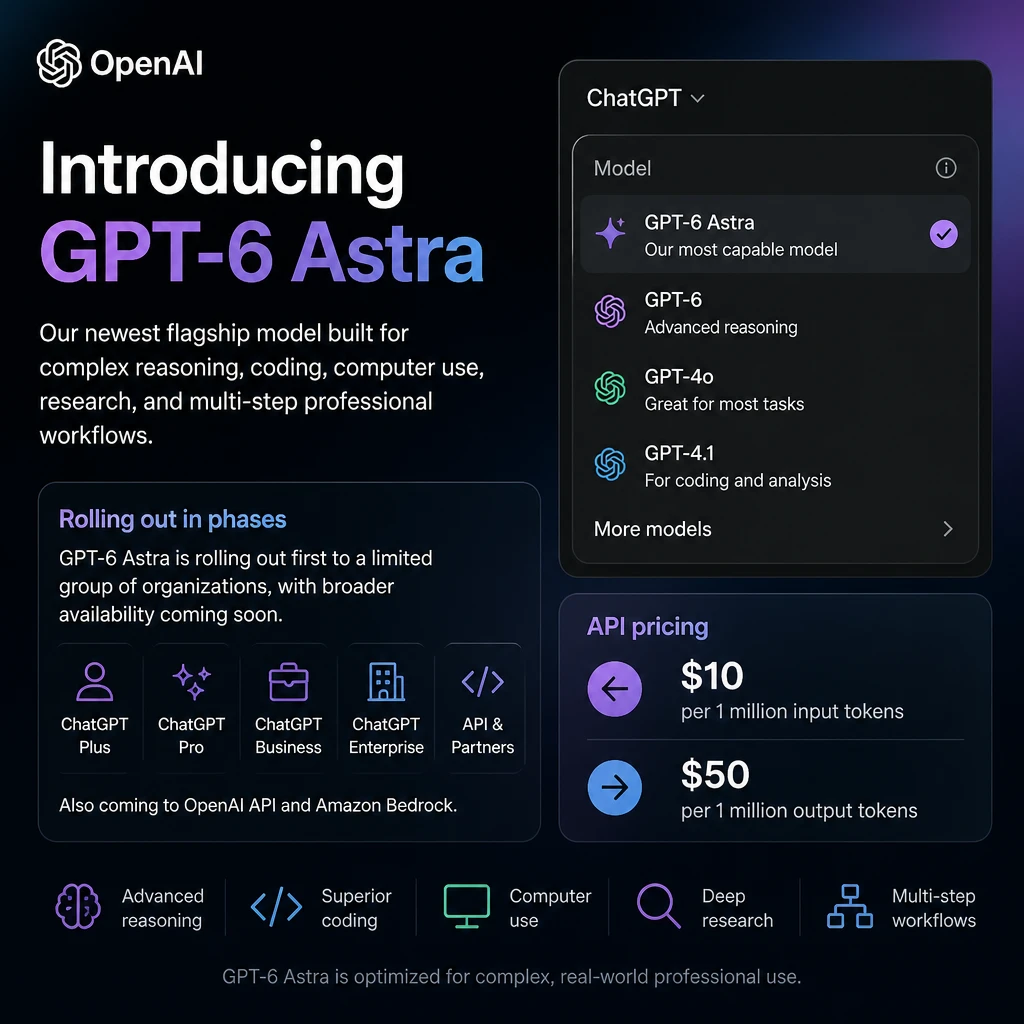
Table of Contents
- What Is GPT-6 Astra?
- When Can You Access GPT-6 Astra?
- What Can GPT-6 Astra Do?
- GPT-6 Astra Pricing
- GPT-6 Astra vs GPT-5.6
- How to Use GPT-6 Astra
- GPT-6 Astra FAQ
What Is GPT-6 Astra?
GPT-6 Astra is OpenAI's latest flagship AI model and the successor to the GPT-5.6 generation.
OpenAI describes Astra as its most capable model, with major improvements in computer use, browsing, software engineering, cybersecurity, science, and professional work.
The biggest difference is that GPT-6 Astra is designed not only to answer questions but also to complete multi-step tasks.
Instead of simply telling you how to update a spreadsheet, for example, an agent powered by Astra can potentially inspect the spreadsheet, reason about the requested changes, make the edits, verify the result, and continue working when the task changes.
GPT-6 Astra at a glance
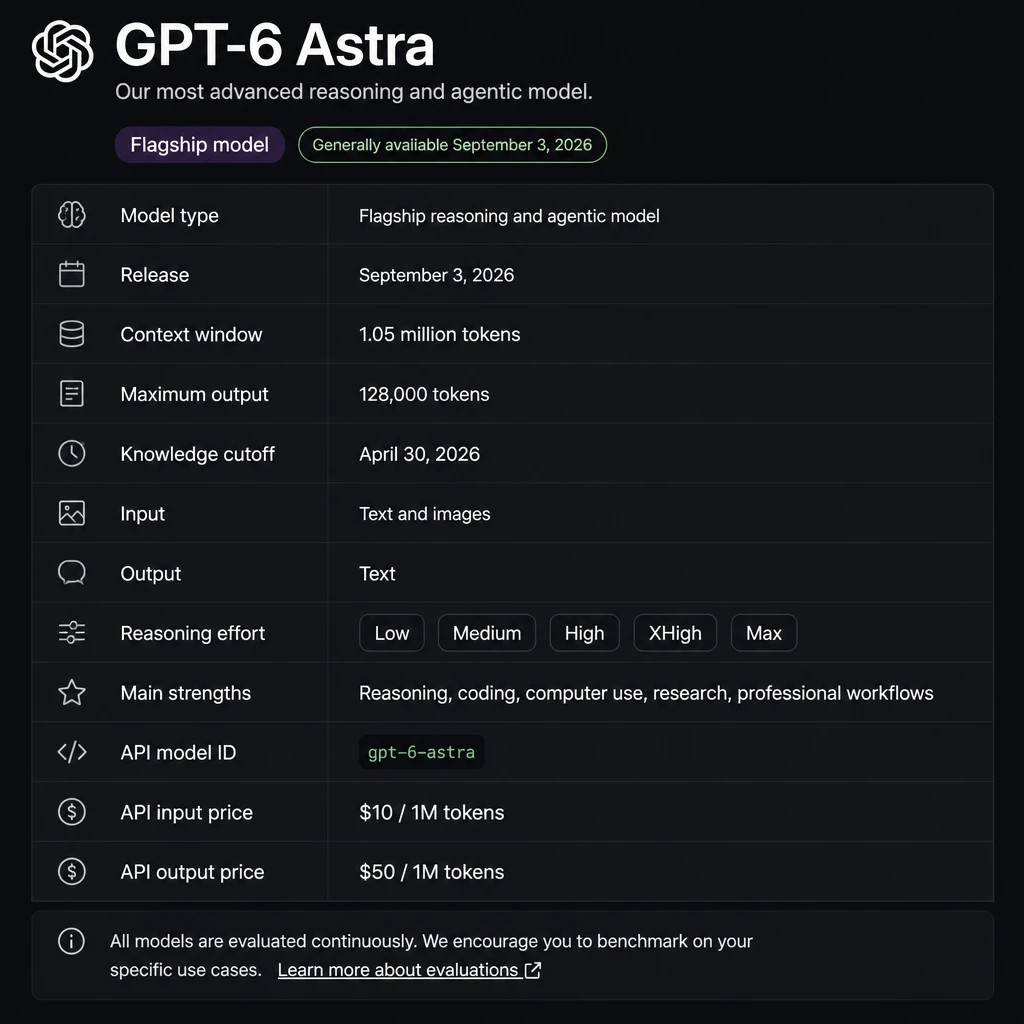
| Feature | GPT-6 Astra |
|---|---|
| Model type | Flagship reasoning and agentic model |
| Release | September 3, 2026 |
| Context window | 1.05 million tokens |
| Maximum output | 128,000 tokens |
| Knowledge cutoff | April 30, 2026 |
| Input | Text and images |
| Output | Text |
| Reasoning effort | Low, medium, high, xhigh, max |
| Main strengths | Reasoning, coding, computer use, research, professional workflows |
| API model ID | gpt-6-astra |
| API input price | $10 / 1M tokens |
| API output price | $50 / 1M tokens |
OpenAI's current model documentation confirms the 1.05 million-token context window, 128K maximum output, five reasoning-effort levels, and $10/$50 input-output pricing.
Why GPT-6 Astra is different
The most important upgrade is not simply that Astra produces better answers.
It is that Astra is built for end-to-end work.
Traditional AI workflow:
text
User → Ask question → AI → Generate answer → User performs the taskA more agentic Astra workflow looks like:
text
User
  ↓
Describe goal
  ↓
GPT-6 Astra plans the task
  ↓
Uses tools / computer / code
  ↓
Checks intermediate results
  ↓
Corrects mistakes
  ↓
Produces the final result
That difference matters most when the task involves multiple steps.
For example:
- Researching a topic across multiple sources
- Working with a large codebase
- Creating and editing spreadsheets
- Building presentations from a template
- Navigating websites
- Testing software
- Analyzing large document collections
- Performing repetitive computer workflows
OpenAI's launch material specifically highlights Astra's ability to work with documents, spreadsheets, presentations, websites, games, software, and professional workflows.
When Can You Access GPT-6 Astra?
Yes, GPT-6 Astra is being released, but access is rolling out gradually.
OpenAI says Astra initially became available to a limited set of organizations. Broader access is planned for ChatGPT Plus, Pro, Business, and Enterprise users, as well as developers using the OpenAI API and customers using Amazon Bedrock.
GPT-6 Astra availability
| User type | Availability |
|---|---|
| Limited organizations | Initial rollout |
| ChatGPT Plus | Rolling out |
| ChatGPT Pro | Rolling out |
| ChatGPT Business | Rolling out |
| ChatGPT Enterprise | Rolling out |
| OpenAI API | Available during rollout |
| Amazon Bedrock | Available during rollout |
Enterprise administrators may also need to enable Astra for their workspace because enterprise access is off by default at launch.
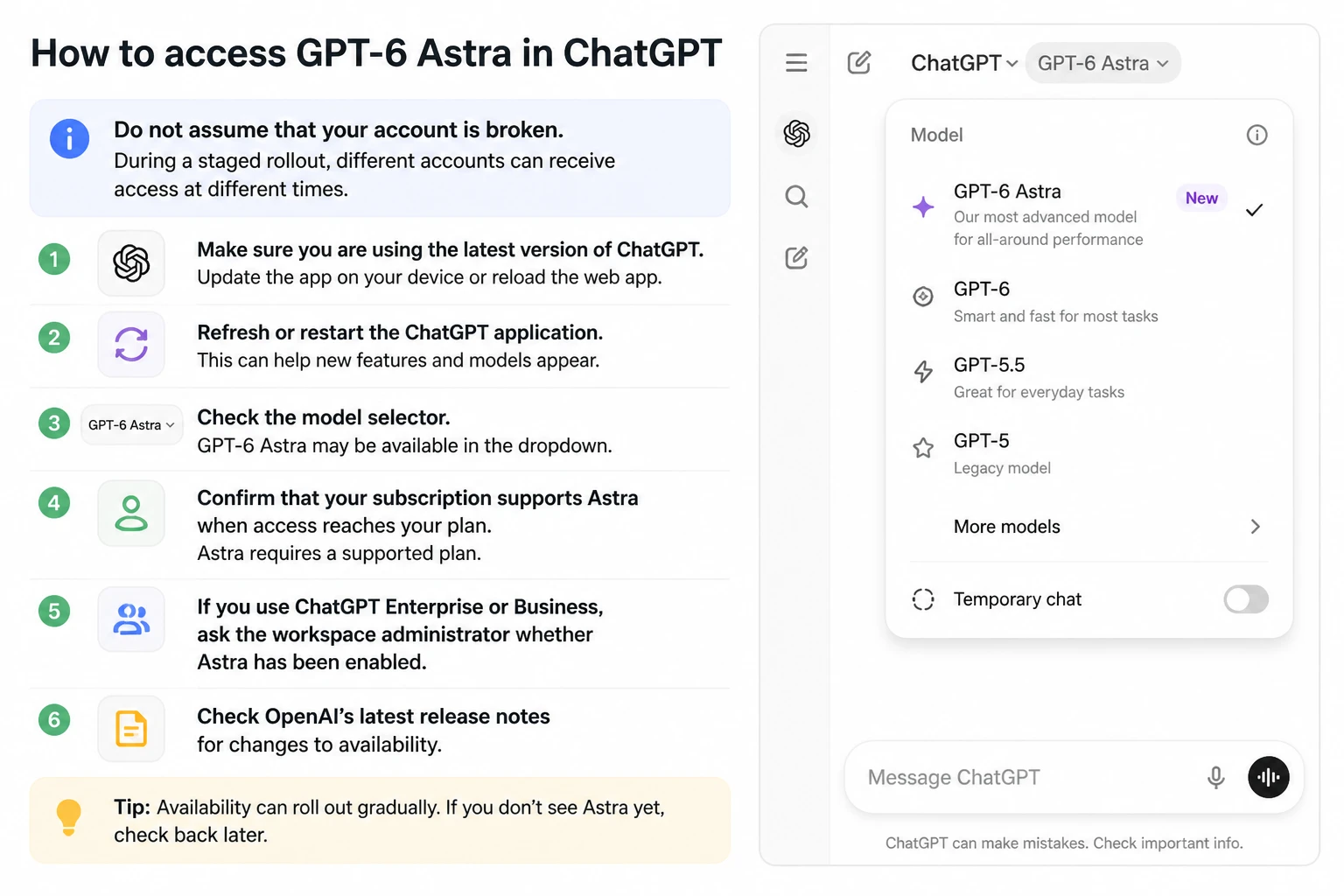
If GPT-6 Astra does not appear in ChatGPT
Do not assume that your account is broken.
During a staged rollout, different accounts can receive access at different times.
Try these steps:
- Make sure you are using the latest version of ChatGPT.
- Refresh or restart the ChatGPT application.
- Check the model selector.
- Confirm that your subscription supports Astra when access reaches your plan.
- If you use ChatGPT Enterprise or Business, ask the workspace administrator whether Astra has been enabled.
- Check OpenAI's latest release notes for changes to availability.
Is GPT-6 Astra available to free ChatGPT users?
At launch, OpenAI's announcement focuses on Plus, Pro, Business, and Enterprise access rather than announcing a general free-tier rollout.
Therefore, if you are specifically looking for GPT-6 Astra, do not assume that a free ChatGPT account will immediately have access.
Availability can change as OpenAI expands the rollout.
What Can GPT-6 Astra Do?
GPT-6 Astra's biggest advantage is its ability to combine reasoning + tools + computer interaction.
That makes it particularly interesting for tasks that previously required users to switch between several applications.
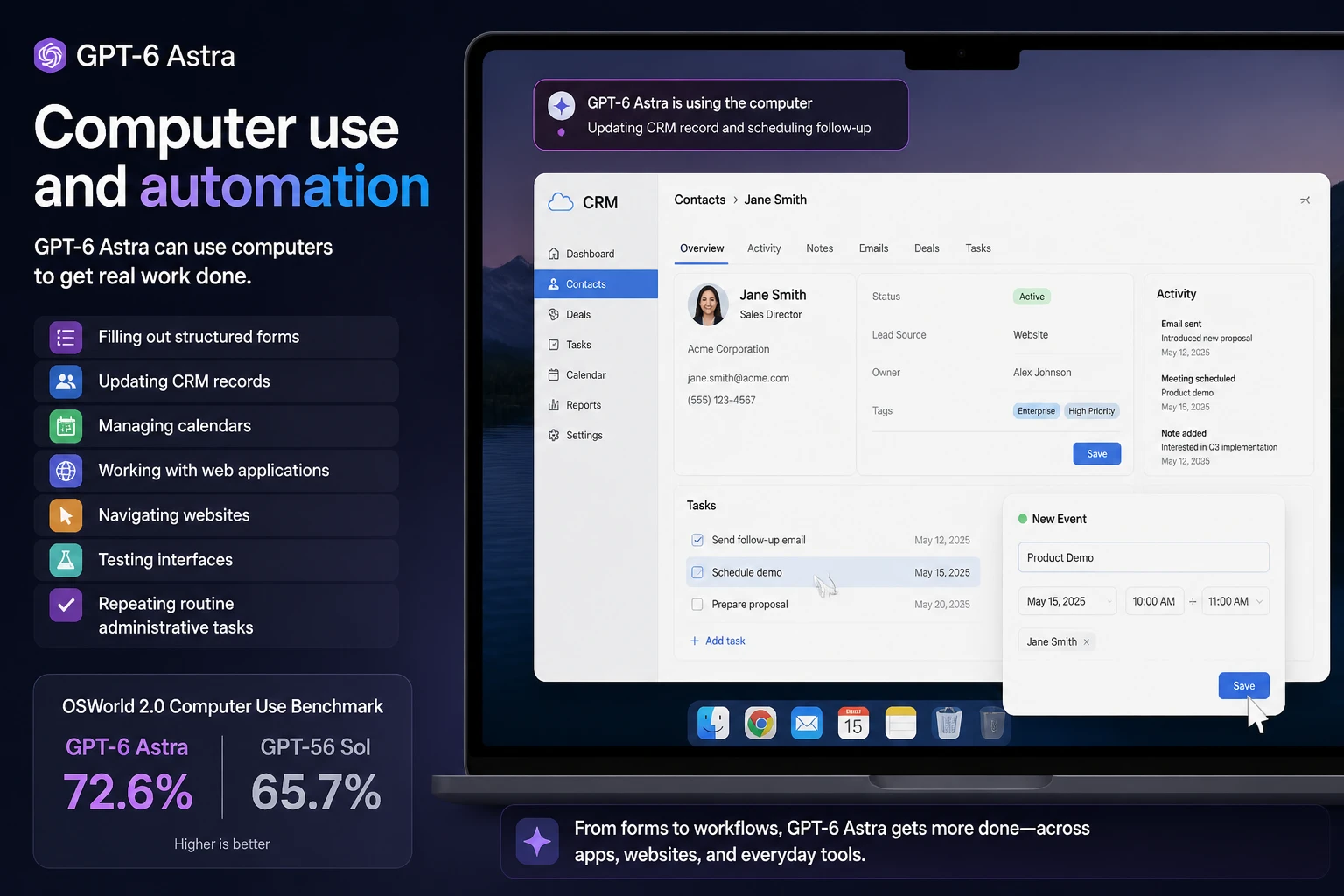
1. Computer use and automation
Computer use is one of Astra's most important capabilities.
Instead of only generating instructions, an AI agent can interact with software and websites as part of a larger workflow.
Potential examples include:
- Filling out structured forms
- Updating CRM records
- Managing calendars
- Working with web applications
- Navigating websites
- Testing interfaces
- Repeating routine administrative tasks
OpenAI reports a 72.6% result for GPT-6 Astra on OSWorld 2.0 in its published computer-use comparison, compared with 65.7% for GPT-5.6 Sol.
2. Coding and software engineering
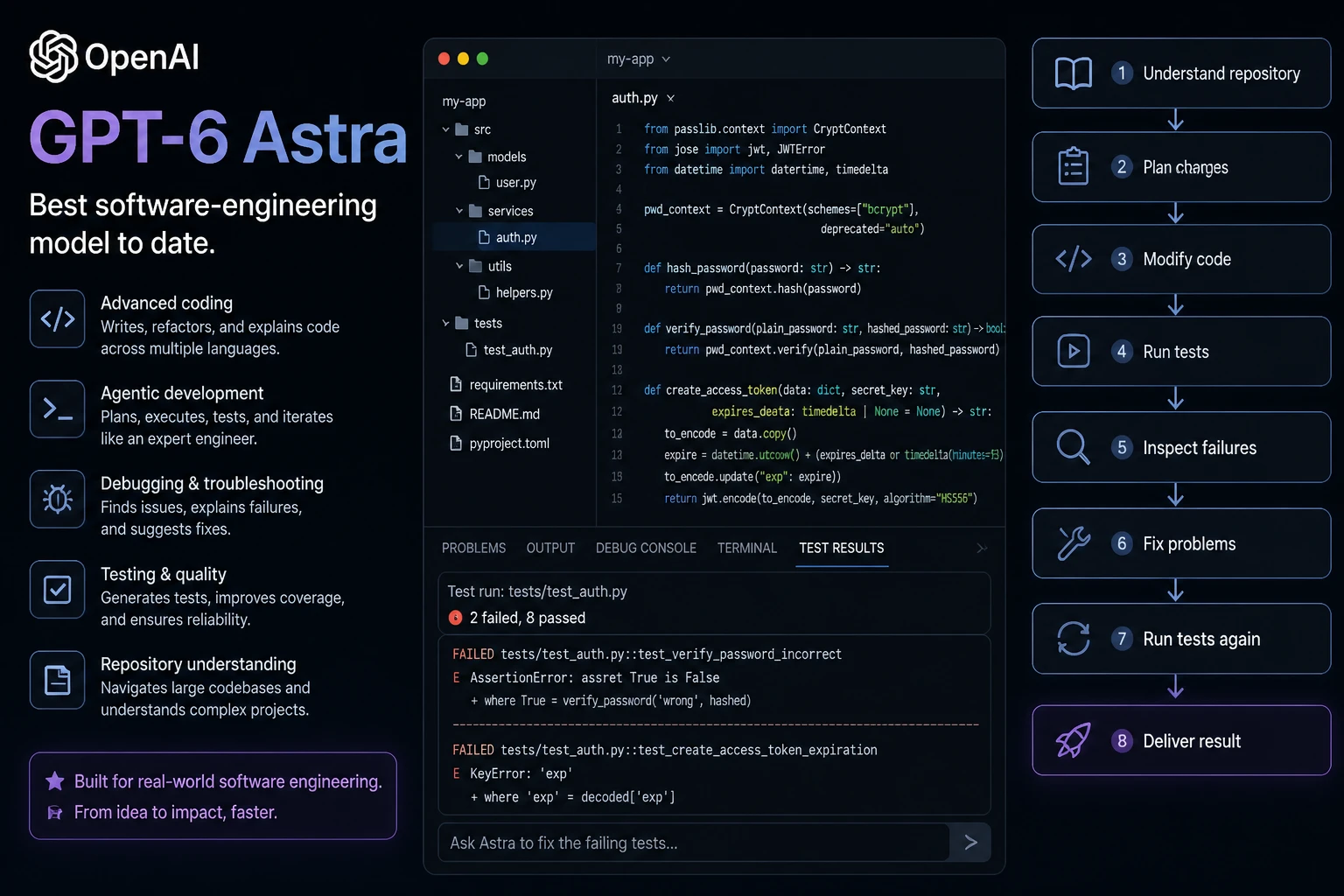
GPT-6 Astra is also designed for complex software-engineering workflows.
The practical difference is important.
A basic coding assistant may generate:
text
function → code → answerA more capable coding agent can work through:
text
Understand repository
        ↓
Plan changes
        ↓
Modify code
        ↓
Run tests
        ↓
Inspect failures
        ↓
Fix problems
        ↓
Run tests again
        ↓
Deliver result
This is especially useful for:
- Debugging existing projects
- Refactoring code
- Implementing features
- Writing tests
- Investigating build errors
- Working across multiple files
- Understanding large repositories
- Iterating on an application
OpenAI describes GPT-6 Astra as its best software-engineering model to date and highlights its performance on coding and agentic development tasks.
3. Research and large documents
The 1.05 million-token context window is particularly useful for large information sets.
For example, you could potentially work with:
- Large codebases
- Long technical documentation
- Multiple research papers
- Legal document collections
- Business reports
- Product specifications
- Large datasets and supporting documentation
However, a large context window does not automatically mean the model will understand every document perfectly.
Good document organization and clear instructions still matter.
A useful workflow is:
text
Upload / provide source material
        ↓
Define the research question
        ↓
Ask the model to identify relevant evidence
        ↓
Analyze findings
        ↓
Ask for contradictions or missing information
        ↓
Generate the final output
4. Documents, spreadsheets, and presentations
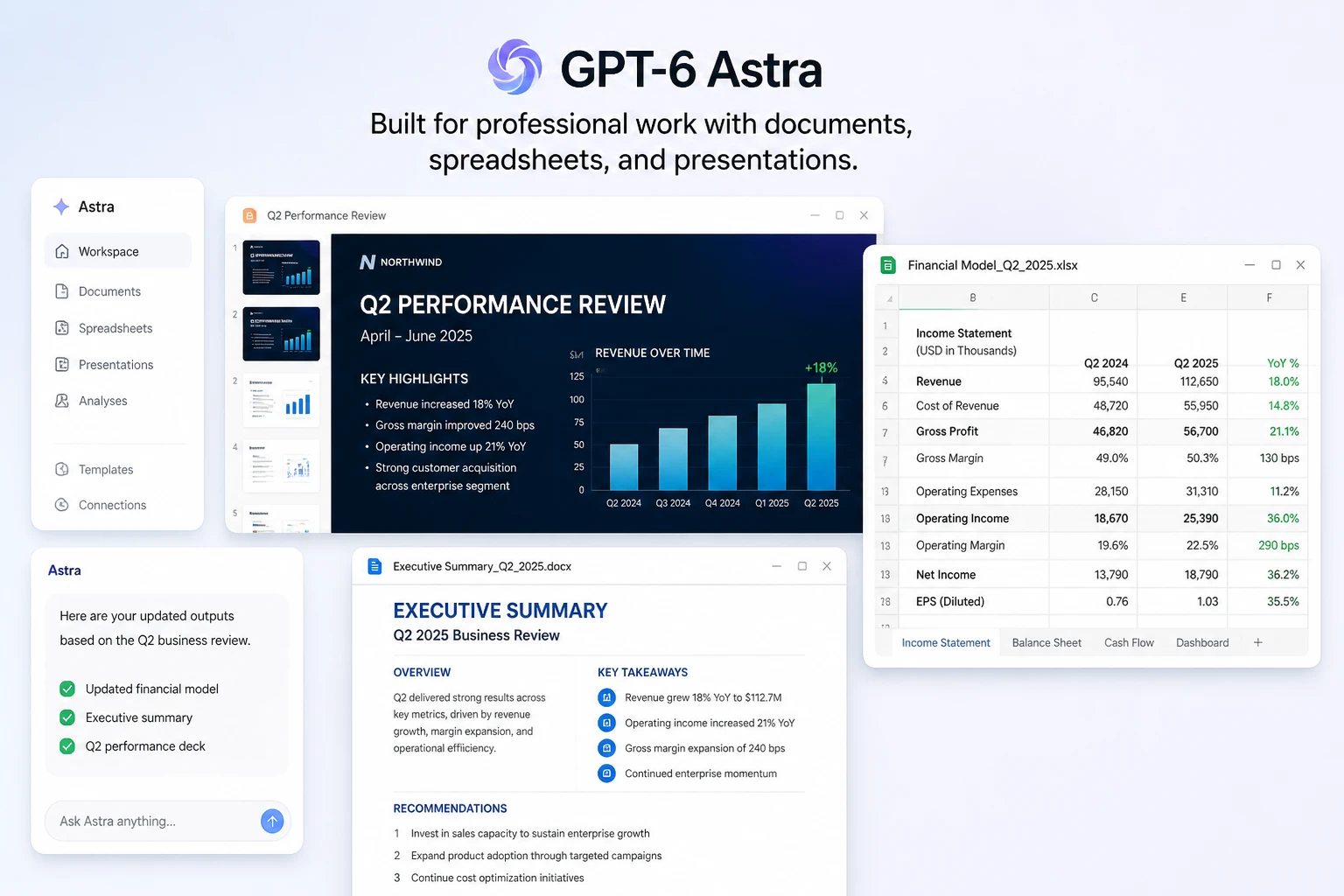
OpenAI also positions Astra for professional work involving documents, spreadsheets, and presentations.
This is useful when the output needs to follow an existing format rather than simply produce plain text.
For example:
- Turn research into a presentation
- Update a financial spreadsheet
- Analyze business data
- Rewrite a report using an existing template
- Create a structured executive summary
- Generate presentation content while preserving a visual style
OpenAI says Astra is trained to better follow templates and produce documents, presentations, spreadsheets, and analyses that match business context and existing standards.
5. Science and mathematics
Astra also targets difficult scientific and mathematical problems.
OpenAI reports that GPT-6 Astra reaches 98% on FrontierMath Tier 4 and 99.9% on ARC-AGI-3 in its launch evaluations.
These benchmarks are impressive, but benchmark scores should not be interpreted as proof that the model can solve every real-world research problem.
The more useful takeaway is that Astra is designed to spend more effort on difficult reasoning tasks and combine that reasoning with tools and external work.
6. Cybersecurity
Cybersecurity is another area where Astra represents a significant capability increase.
OpenAI says GPT-6 Astra is its first model to reach the Critical cybersecurity capability level under its Preparedness Framework.
Because these capabilities can also create significant misuse risks, OpenAI has added stronger safeguards, monitoring, and access controls.
For ordinary users, this means cybersecurity capabilities should not be viewed simply as "a better hacking tool."
Instead, the more relevant applications include defensive security research, code analysis, vulnerability understanding, and security workflows within permitted environments.
GPT-6 Astra Pricing
How much does GPT-6 Astra cost?
For API usage, OpenAI currently lists:
| API usage | Price |
|---|---|
| Input | $10 / 1M tokens |
| Cached input | $1 / 1M tokens |
| Cache write | $12.50 / 1M tokens |
| Output | $50 / 1M tokens |
OpenAI's current developer documentation lists $10 per million input tokens and $50 per million output tokens, with separate pricing for cached input and cache writes.
What about long-context pricing?
GPT-6 Astra supports a context window of up to 1.05 million tokens.
However, OpenAI's API pricing can differ when very large inputs exceed the standard threshold.
For inputs above 272K tokens, the published pricing is higher:
| Usage | Standard | Long context |
|---|---|---|
| Input | $10 / 1M | $20 / 1M |
| Output | $50 / 1M | $75 / 1M |
If you are building an application that routinely sends hundreds of thousands of tokens per request, this distinction can materially affect your API budget.
Is GPT-6 Astra expensive?
For casual ChatGPT users, API token pricing is not the most important number.
If you are using Astra through ChatGPT, the relevant question is whether your existing subscription includes access.
For developers, however, the cost can become significant when Astra is used for:
- Long-context analysis
- Agentic workflows
- Repeated coding tasks
- Computer-use automation
- High-volume API applications
A good strategy is to use Astra where its additional reasoning or agentic capabilities actually improve the result rather than automatically using it for every request.
GPT-6 Astra vs GPT-5.6
If you already use GPT-5.6, the most important question is not simply whether Astra is "better."
The better question is:
Do your tasks benefit from the capabilities Astra is designed to improve?
GPT-6 Astra vs GPT-5.6 comparison
| Dimension | GPT-6 Astra | GPT-5.6 |
|---|---|---|
| Model generation | New flagship | Previous flagship generation |
| Complex reasoning | Excellent | Very strong |
| Computer use | Major focus | Strong |
| Software engineering | Major focus | Strong |
| Professional workflows | Major focus | Strong |
| Context window | 1.05M tokens | Smaller |
| Reasoning control | Low → Max | Depends on model configuration |
| Agentic workflows | Major focus | Supported |
| API price | $10 input / $50 output | Lower |
| Best for | Difficult end-to-end tasks | General high-quality AI work |
OpenAI's published computer-use results show Astra at 72.6% on OSWorld 2.0 versus 65.7% for GPT-5.6 Sol, while AutomationBench shows 41.4% versus 18.1%.
When should you choose GPT-6 Astra?
Choose GPT-6 Astra when you need:
- Complex reasoning
- Multi-step workflows
- Computer interaction
- Advanced coding
- Large-context analysis
- Research involving many documents
- Professional document generation
- More autonomous task execution
When is GPT-5.6 enough?
GPT-5.6 may still be sufficient for:
- Everyday questions
- Simple writing
- Basic coding
- Summaries
- Brainstorming
- Routine content generation
- Tasks where maximum reasoning is unnecessary
The key point is that the newest model is not automatically the most cost-effective model for every task.
How to Use GPT-6 Astra
The exact interface may change as OpenAI continues rolling out Astra, but the general workflow is straightforward.
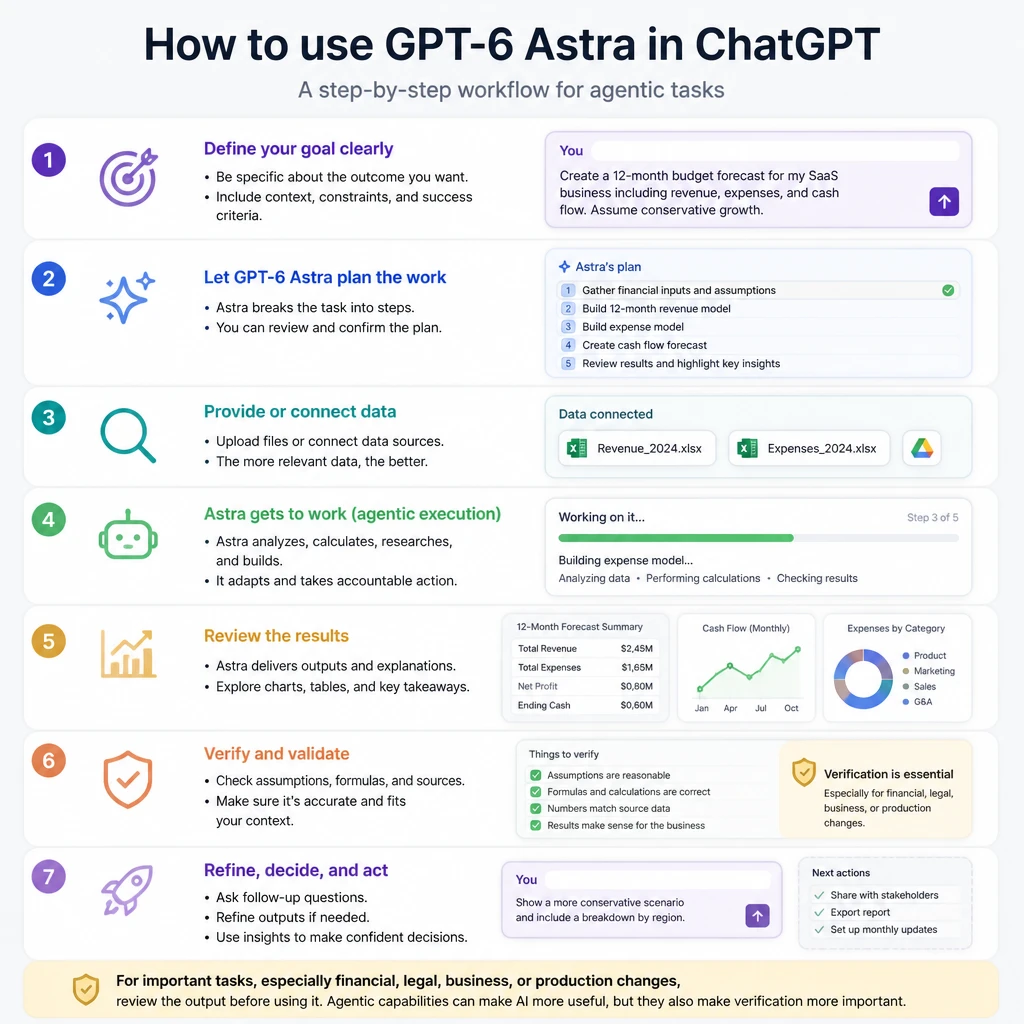
Method 1: Use GPT-6 Astra in ChatGPT
Step 1: Open ChatGPT
Log in to your ChatGPT account.
Step 2: Open the model selector
Look for GPT-6 Astra once it becomes available to your account.
Step 3: Select GPT-6 Astra
Choose Astra for tasks that require deeper reasoning, coding, research, or multi-step work.
Step 4: Describe the desired outcome
Do not only describe individual actions.
Instead, explain the final result you want.
For example:
"Analyze these 10 reports, identify the three largest changes, create a summary table, and prepare a five-slide executive presentation."
This gives the model a clear objective instead of a sequence of disconnected commands.
Step 5: Specify constraints
Include information such as:
- Required format
- Deadline
- Data sources
- Output length
- Things the model must not change
- Approval points
- Quality requirements
Step 6: Review the result
For important tasks, especially financial, legal, business, or production changes, review the output before using it.
Agentic capabilities can make AI more useful, but they also make verification more important.
Method 2: Use GPT-6 Astra through the API
Developers can access GPT-6 Astra using the model ID:
text
gpt-6-astraOpenAI's current documentation recommends using the Responses API for tool-enabled workflows.
A simplified workflow looks like this:
text
Your application
      ↓
OpenAI API
      ↓
gpt-6-astra
      ↓
Reasoning
      ↓
Tools / application logic
      ↓
Result
For production applications, you should additionally consider:
- Token usage
- Context size
- Caching
- Rate limits
- Tool permissions
- Error handling
- Human approval for consequential actions
- Logging and monitoring
Example API workflow
A typical application might use Astra to:
- Receive a user request.
- Analyze the request.
- Retrieve relevant data.
- Call application tools.
- Process the results.
- Validate the output.
- Return structured data to the application.
This is where GPT-6 Astra becomes more interesting than a conventional chatbot: the model can become part of an end-to-end workflow rather than simply a text-generation component.
GPT-6 Astra Benchmarks: What Do They Actually Mean?
Benchmarks are useful, but they should not be the only reason to choose a model.
OpenAI reports several strong results for GPT-6 Astra, including:
| Benchmark | GPT-6 Astra |
|---|---|
| ARC-AGI-3 | 99.9% |
| FrontierMath Tier 4 | 98% |
| OSWorld 2.0 | 72.6% |
| AutomationBench | 41.4% |
| ScreenSpot-Pro | 92.7% |
| BenchCAD | 95.9% |
These are vendor-reported launch results, so they should be interpreted as evidence of capability rather than a universal guarantee of real-world performance.
What matters more than the benchmark score?
For most users, the practical questions are:
Can it complete my task?
Can it recover when something goes wrong?
Can it follow my existing workflow?
Can it work with my tools and data?
Does the improvement justify the additional cost?
Those questions are usually more useful than comparing one benchmark score in isolation.
GPT-6 Astra Limitations
GPT-6 Astra is powerful, but it is not autonomous intelligence without limitations.
1. Availability is still changing
The launch is being rolled out progressively.
Your account may not receive access at the same time as another account.
2. Model knowledge has a cutoff
The current API documentation lists a knowledge cutoff of April 30, 2026.
For newer information, use appropriate browsing or retrieval tools rather than relying only on the model's internal knowledge.
3. Agentic actions require supervision
The more actions an AI system can perform, the more important permissions and verification become.
For example, an AI agent that can read a document is lower-risk than one that can:
- Send emails
- Modify production code
- Transfer money
- Delete records
- Change account settings
- Submit forms
For consequential tasks, human approval should remain part of the workflow.
4. Benchmark performance is not the same as reliability
A high benchmark score does not guarantee perfect performance in your particular environment.
Real-world results depend on:
- Prompt quality
- Available tools
- Data quality
- Application architecture
- Permissions
- Error handling
- Human review
5. Cybersecurity capabilities require additional safeguards
OpenAI has classified Astra at the Critical cybersecurity capability level and has introduced additional protections around these capabilities.
That is important because the same capabilities that help defenders can potentially create new misuse risks.
GPT-6 Astra FAQ
What is GPT-6 Astra?
GPT-6 Astra is OpenAI's latest flagship AI model, designed for complex reasoning, coding, computer use, research, and professional multi-step workflows.
Is GPT-6 Astra available now?
Yes. GPT-6 Astra is being rolled out, beginning with a limited set of organizations. OpenAI says broader availability is coming to ChatGPT Plus, Pro, Business, and Enterprise users, as well as the API and Amazon Bedrock.
Is GPT-6 Astra free?
OpenAI has not announced general free-tier access to Astra as part of the launch. Access is being expanded through supported ChatGPT plans and paid API usage.
How much does GPT-6 Astra cost?
The current API price is $10 per 1 million input tokens and $50 per 1 million output tokens. Cached input and cache-write pricing are lower/different, and long-context requests can have higher rates.
What is the context window of GPT-6 Astra?
GPT-6 Astra supports a context window of up to 1.05 million tokens, with a maximum output of 128,000 tokens.
Is GPT-6 Astra better than GPT-5.6?
For difficult reasoning, coding, computer use, and agentic workflows, Astra is designed as a major step forward from GPT-5.6. However, GPT-5.6 can still be sufficient for many routine tasks where the additional capabilities are unnecessary.
Can GPT-6 Astra use a computer?
Yes. Computer use is one of Astra's major capabilities. OpenAI reports strong results on computer-use benchmarks and positions Astra for multi-step workflows involving websites, applications, and professional software.
Does GPT-6 Astra support images?
Yes. The model accepts image input in addition to text. Its current API documentation lists text and image input with text output.
What is the GPT-6 Astra API model ID?
The current API model ID is:
text
gpt-6-astraIs GPT-6 Astra safe?
OpenAI describes Astra as its most aligned model while also recognizing that its increased capabilities introduce new risks. Astra has reached the Critical cybersecurity capability threshold, so OpenAI has added stronger safeguards, monitoring, and access controls.
Final Verdict: Is GPT-6 Astra Worth Using?
GPT-6 Astra is most interesting when you need AI to do more than generate text.
Its strongest use cases are complex reasoning, software engineering, computer use, research, large-context work, and professional workflows.
If you only need quick answers, simple writing, or basic brainstorming, you may not notice enough difference to justify using the most capable model every time.
But if your work involves long documents, large codebases, multi-step workflows, browser interaction, or tasks that require the AI to reason and act repeatedly, Astra is a much more significant upgrade.
The simplest way to think about it is:
GPT-5.6 is a powerful AI assistant. GPT-6 Astra is designed to become a more capable AI worker.
As access expands and users put Astra through real-world workloads, the most useful comparison will move beyond benchmark scores and toward one question:
How much real work can GPT-6 Astra reliably complete for you?
Try More AI Tools
If you are exploring different AI products and tools, FamilyPro helps users discover and access a range of AI services from one platform.
Explore AI Tools on FamilyPro →
Editorial Note
This article was last updated on September 4, 2026, shortly after the GPT-6 Astra launch.
GPT-6 Astra's availability, pricing, model capabilities, and product features may change as OpenAI continues its rollout. Readers should verify the latest availability and pricing directly through OpenAI before making purchasing or development decisions.