
Grok 4.5 Pricing and Benchmarks: Is It Worth Using?
Grok 4.5 landed on July 8, 2026, and it isn't another "the chatbot got chattier" update. SpaceXAI built this one with Cursor, trained it on tens of thousands of NVIDIA GB300 GPUs, and pointed it straight at coding, agentic tasks, and knowledge work. Here's what that actually means for you.
If you were hoping Grok 4.5 would dunk on every benchmark and make Claude irrelevant, slow down. If you were hoping it would let you run real engineering agents at a fraction of what Opus and GPT-5.5 cost, you're closer to the truth.
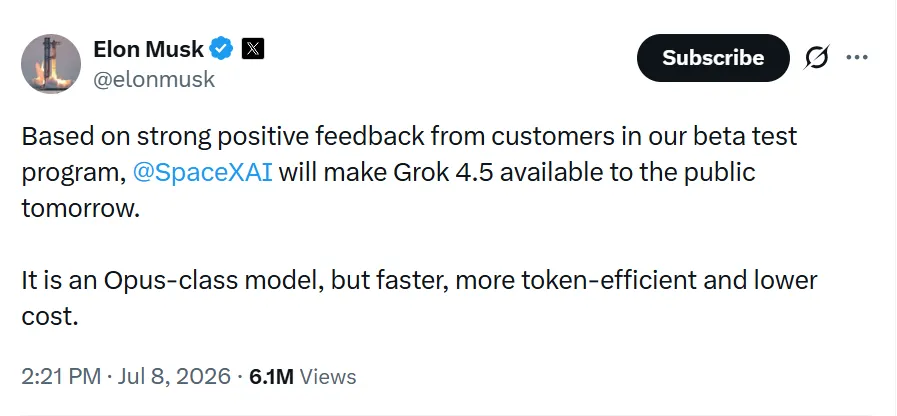
Musk called it an "Opus-class" model. Strip the marketing off that phrase and it means "roughly comparable to Claude Opus 4.7, but faster and cheaper," not "we beat Claude across the board." The honest story is more interesting than the press release, so let's get into it.
What Grok 4.5 actually is
Grok 4.5 is SpaceXAI's new flagship model built to excel at coding, agentic tasks, and knowledge work. The company calls it "our strongest model ever." It was trained alongside Cursor (the AI code editor that SpaceX agreed to acquire weeks before launch) on tens of thousands of NVIDIA GB300 GPUs. It's now the default model inside Grok Build (the terminal-native agent tool), available in Cursor on all plans, and live through the SpaceXAI console and API.
That lineage and positioning matters. The previous Grok 4 was a general intelligence model pitched at chat, real-time search, and tool use. Grok 4.5 sharpens the focus: writing code, fixing bugs across large repos, running terminal tasks, and handling multi-step engineering problems where the model has to plan, act, and iterate. The RL training alone spans hundreds of thousands of tasks, centered on multi-step software engineering, with an asynchronous training stack that lets agentic rollouts run for hours while learning continues across tens of thousands of GPUs.
It also targets knowledge work. SpaceXAI specifically called out Excel, PowerPoint, and Word capabilities: complex multi-sheet financial models with web research baked in, native-shape charts in slides, and structured writing in Word. The Office integration goes through dedicated Microsoft Marketplace plugins for Word, PowerPoint, and Excel. The pitch isn't only "for programmers." It's "for anyone whose job involves producing structured output, fast."
One detail that stands out in the official announcement: Grok 4.5 can build complete, functional applications from a single prompt. SpaceXAI's examples include a Three.js solar system simulator with realistic orbital mechanics, adjustable time, and a modern HUD, generated from one prompt with minimal specification. That's not a claim about benchmark dominance, it's a claim about practical output quality. Whether it delivers consistently across different prompt types is something you'd want to test yourself.
The benchmarks, read honestly
SpaceXAI published engineering results across five benchmarks, comparing Grok 4.5 against Fable 5 (max), GPT-5.5 (xhigh), Opus 4.8 (max), Opus 4.7 (max), and GLM 5.2. A caveat up front: these numbers come from each vendor's own published harnesses, not a single neutral suite. The DeepSWE benchmarks were run by Datacurve using each provider's harness. Treat them as directional, not gospel.
| Benchmark | Grok 4.5 | Top competitor | What it means |
|---|---|---|---|
| SWE Marathon resolve rate, pass@1 | 29.0% | Opus 4.8: 26.0% Fable 5: 24.0% | Grok 4.5 leads here |
| Terminal Bench 2.1 | 83.3% | Fable 5: 84.3% GPT 5.5: 83.4% | 0.1pp behind GPT-5.5, effectively tied |
| DeepSWE 1.0 | 62.0% | Fable 5: 66.1% GPT 5.5: 64.3% | Beats both Opus versions clearly |
| SWE Bench Pro | 64.7% | Fable 5: 80.4% Opus 4.8: 69.2% | Ahead of Opus 4.7, GPT-5.5, GLM 5.2 |
| DeepSWE 1.1 | 53% | Fable 5: 70% GPT 5.5: 67% | Trails all three leaders here |
The pattern is consistent. On SWE Marathon, which measures sustained multi-step engineering across repos, Grok 4.5 actually leads the field. On terminal-style agent work, it's effectively tied with the best. On the two DeepSWE benchmarks (sweatier, more curated SWE tasks), it's competitive but not dominant. Fable 5 remains the highest-ceiling model across all five tests.
Grok 4.5 was never built to win the raw peak-score race, though. The pitch is intelligence per unit of time and cost, as SpaceXAI puts it. And on that front, the token efficiency numbers get genuinely interesting.
The real selling point: token efficiency
SpaceXAI makes two claims about token efficiency. The first is specific: on SWE Bench Pro tasks, Grok 4.5 averaged 15,954 output tokens to complete a job, against Opus 4.8 (max) at 67,020. That's about 4.2× fewer tokens for the same class of task. The second is broader: the company says Grok 4.5 is roughly twice as token-efficient as comparable leading models, solving tasks in fewer steps.
Why this matters is simple math. What you actually pay for an agent isn't the sticker price per token. It's the sticker price multiplied by how many tokens the model burns through to finish, multiplied by how many rounds it takes, multiplied by how often you retry. A model with a slightly lower per-token price but four times the token spend per task is more expensive in practice, not less. That's the whole game.
SpaceXAI also points out that Grok 4.5 serves at "fast-model speeds" of 80 tokens per second. That puts it in the latency class of a flash model rather than a heavy reasoner. For interactive coding where you're watching the model work, 80 TPS is a real quality-of-life difference over models that trickle tokens at 15-30 TPS. 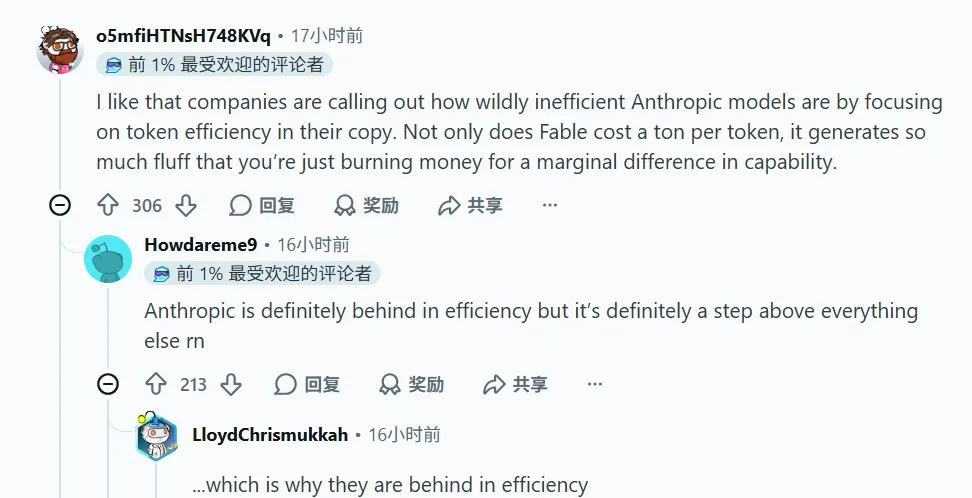
How Grok 4.5 was trained
The official post gives a few details worth knowing if you're trying to understand why the model behaves the way it does.
Pre-training ran across tens of thousands of GB300 GPUs. Beyond raw token volume, SpaceXAI invested in data filtering and curation: deduplication, quality scoring, and domain-focused selection to keep the training mixture high-coverage and high-signal. They then ran reinforcement learning over hundreds of thousands of tasks, centered on multi-step software engineering and technical work, using both automated and model-based grading.
The training stack is built for asynchrony, so agentic rollouts can keep running for hours while learning continues across the cluster. SpaceXAI says the result is "more intelligent and efficient reasoning on real engineering and agentic tasks," which is a roundabout way of saying they trained the model to think in terms of getting things done, not just producing answers.
What it costs
Two ways to pay for Grok 4.5, and the gap between them is wide.
The API (for developers)
| Model | Input / MTok | Output / MTok |
|---|---|---|
| Grok 4.5 | $2 | $6 |
| Claude Opus 4.8 | $5 | $25 |
On raw per-token price, Grok 4.5 is already cheaper than Opus 4.8. Stack the 4.2× token efficiency on top, and the effective cost gap per completed engineering task gets dramatic. For a team running agents all day, that's the kind of difference that shows up on the invoice at the end of the month.
The subscription (for everyone else)
If you're not wiring up API calls, you access Grok through a subscription. The standard retail route is SuperGrok at $30/month for full Grok access (DeepSearch, Voice, Imagine, and the latest models as they roll out). X Premium+ bundles the same Grok access with X platform perks for $40/month, and SuperGrok Heavy runs $300/month for power users who need Grok 4 Heavy and the highest rate limits.
Thirty dollars a month is a real commitment if you just want to kick the tires on Grok 4.5's coding and agent chops. And that's where things get interesting.
Sponsored · FamilyPro
Get full Grok access for $5.99/month instead of $30
Here's the deal most people don't know about. FamilyPro lets you join a shared Grok family plan, so you get the same Grok access the retail SuperGrok plan offers, at roughly 80% off.
Sponsored · FamilyPro
Try Grok for $5.99/month instead of $30
FamilyPro gives you full Grok access through a shared family plan, helping you test Grok 4.5’s coding, agent, and productivity features at roughly 80% less than the standard SuperGrok price.
$5.99/month$30/month
FamilyPro has operated for over five years, serves 100,000+ members, reports 99.8% uptime, and offers lifetime account replacement with no-questions-asked refunds. You can also find ChatGPT Plus, Claude, Perplexity, Cursor, Canva, Netflix, Spotify, and more on the same platform.
Try Grok via FamilyPro →Grok 4 vs. Grok 4.5: where the shift is
The cleanest way to understand Grok 4.5 is to line it up against what came before it.
| Grok 4 | Grok 4.5 | |
|---|---|---|
| Positioning | General intelligence model | Engineering / agent / knowledge-work model |
| Main pitch | Reasoning, search, tool use | Coding, agent execution, speed, cost |
| Who it's for | Consumers and developers chatting | Cursor users, Grok Build, API, office work |
| Competes with | ChatGPT, Claude, Gemini | Claude Code, Cursor-native models, OpenAI's coding agents |
Grok 4 was about being a smart, well-rounded assistant with real-time data from X and the web. Grok 4.5 is about being a productive one. The model isn't trying to win the chatbot beauty pageant. It's trying to be the thing you reach for when you have a repo to fix, a spreadsheet to model, or an agent loop to run.
What's a real upgrade and what's marketing
I'd separate the claims into two piles.
Genuinely new and valuable:
- The coding-and-agent focus isn't marketing garnish. The RL training spans hundreds of thousands of software engineering tasks, and the model was co-trained with Cursor from the start.
- Aggressive API pricing. $2 input and $6 output per million tokens, confirmed by SpaceXAI, Reuters, and the official docs.
- Token efficiency is the real argument. 4.2× fewer output tokens than Opus 4.8 on SWE Bench Pro, and about twice as efficient as comparable leading models on tasks in the same class. If independent testing confirms this, the cost math shifts meaningfully.
- The Cursor integration is straightforward. Grok 4.5 is available on all Cursor plans today, and there's a limited-time free usage promo in both Cursor and Grok Build.
- SWE Marathon lead. Grok 4.5 scores 29.0% (pass@1) vs Opus 4.8 at 26.0%. On the benchmark closest to "can it finish a long engineering task end to end," it's currently the leader among the models tested.
Worth keeping a skeptical eye on:
- The benchmarks are mostly vendor-published. Wait for neutral third-party runs before declaring a winner.
- "Opus-class" is positioning language, not a measured result. Musk's own framing was "roughly comparable to Opus 4.7, but much faster." That's "same tier, better speed and price," not "objectively superior."
- There's no solid public evidence yet that Grok 4.5 leads on long-form writing, serious research, or citation reliability. If your job is producing careful, sourced long-form content, don't switch based on a launch post.
- The EU is out of luck for now. SpaceXAI says Grok 4.5 products and API aren't available in the EU yet, with mid-July as the expected timeline.
So should you care?
Depends on what you do all day.
| If you... | Is Grok 4.5 worth your time? |
|---|---|
| Write code, fix bugs, refactor projects | Yes, genuinely |
| Live in Cursor for daily development | Yes, it's right there |
| Build small tools or full apps with one prompt | Worth trying in Grok Build |
| Automate Excel, PowerPoint, or Word workflows | Worth a test |
| Do real-time search Q&A | Grok 4 or the Grok app still does this well |
| Produce long-form or SEO content | Needs real testing before you commit |
| Manage API costs for agents at scale | Very much worth a look |
My read: Grok 4.5 isn't a "the chatbot got an upgrade" release. It's a "productivity model got commercialized" release. SpaceXAI's own framing is "the highest intelligence per unit of time and cost," and that's exactly the play. Take near-frontier capability, add flash-model speeds, cut the token burn dramatically, go deep on Cursor and Grok Build integration, and compete on the developer and enterprise knowledge-work markets.
The pressure it puts on OpenAI and Anthropic isn't on the "who has the biggest benchmark number" leaderboard. It's on the unit cost of high-frequency engineering work. If Grok 4.5 stays stable on real projects, it's well suited to be a code agent, an internal SaaS copilot, an office automation agent, a batch content processor, or a low-cost API alternative.
But I wouldn't call it a flat-out Claude or GPT killer today. The more accurate statement: Grok 4.5 is probably the most price-aggressive frontier-tier engineering model available right now, especially for code and agent work. For general writing, complex research, and non-English content quality, the jury's still out until we see real-world samples.
The cheapest way to find out where you land is to actually run it. At $5.99/month through FamilyPro instead of $30 retail, the cost of being wrong is a coffee, not a subscription.
How to actually use Grok 4.5 (and where to find it)
Here's something the launch coverage mostly skips over, and it's going to trip up a lot of people.
If you open grok.com or the Grok App and look for a model selector that says "Grok 4.5," you probably won't find it. The regular Grok chat interface doesn't surface Grok 4.5 the way it does Grok 4. That's not a bug, it's intentional. Grok 4.5 was built for agentic work, not casual conversation, and SpaceXAI ships it through different entry points than the standard chatbot.
This creates a natural question: if I'm not a developer, am I locked out? The short answer is no, but you need to know which door to walk through. The official release page lists exactly four places where Grok 4.5 is live, and the regular Grok chat window isn't one of them.
Method 1: Grok Build (terminal-native agent)
This is the most direct route and the one SpaceXAI highlights first. Grok 4.5 is the default model inside Grok Build, which is xAI's terminal-native agent tool. Think of it as a coding copilot that lives in your terminal rather than a browser tab.
Getting it running takes one command:
curl -fsSL https://x.ai/cli/install.sh | bashAfter that, navigate to your project directory and launch Grok Build. From there you can throw real engineering tasks at Grok 4.5: ask it to audit payment logic in an API, check for config drift between Docker and Kubernetes, refactor a module, run tests, or do multi-step agent workflows. Grok Build runs with free usage for a limited time, so you can stress-test the model without handing over a credit card.
If you're a developer, this is the path of least resistance. If you're not comfortable in a terminal, skip to method 3 or 4.
Method 2: Cursor (all plans)
Grok 4.5 is available on every Cursor plan, and SpaceXAI is running a limited-time free usage promo. The setup is straightforward:
- Open Cursor
- Go to the model selector
- Find Grok 4.5 in the list
- Select it as your chat or agent model
If you don't see it, here's what usually fixes it: update Cursor to the latest version, sign out and back in to refresh the model list, or check whether your account region is supported yet. The model rollout can take a few days to hit every user.
For the kind of person who already lives in Cursor, this is a no-brainer. Pick it from the dropdown and start comparing its output and speed to whatever model you've been using.
Method 3: xAI API (for developers who want programmatic access)
The API model name is grok-4.5. If you already have an xAI API key, you swap the model name and go. Here's a minimal call that asks it to find and fix a bug:
curl
-H "Authorization: Bearer $XAI_API_KEY"
-H "Content-Type: application/json"
-d '{
"model": "grok-4.5",
"input": "Find and fix the bug, then explain it: function median(a){a.sort();return a[a.length/2]}"
}'
The only line that matters is "model": "grok-4.5". Everything else is standard xAI API boilerplate.
API pricing is $2 per million input tokens and $6 per million output tokens, confirmed in the official docs. New accounts also get $25 in free credits, and if you opt into the data sharing program you can pull up to $150/month more, for $175/month total in free API credits. That's enough to run serious tests without spending anything.
Method 4: Microsoft Office plugins (for the non-programmer crowd)
If terminals and API keys aren't your thing, this is your entry point. SpaceXAI confirmed that Grok 4.5 is the default model in its Word, PowerPoint, and Excel plugins, available through the Microsoft Marketplace.
What this actually unlocks:
- Excel: multi-sheet financial models, complex formulas, and web research inside spreadsheets
- PowerPoint: native-shape charts, flow diagrams, and full slide decks from prompts
- Word: structured reports, document cleanup, and long-form content generation
For financial analysts, consultants, researchers, and anyone whose job involves producing polished Office documents, this is the closest you'll get to using Grok 4.5 the way you'd use a normal AI tool, without touching code or a terminal.
Quick check if you're looking for it in the wrong place: open grok.com or the Grok App, look near the input box for a model selector. If you see "Grok 4.5" as an option, pick it. If not, your account or region hasn't gotten that dropdown yet, and you should use one of the four methods above instead. The official release page doesn't list the standard Grok chat window as a delivery channel for Grok 4.5, so a missing selector is expected, not broken.
Region note
EU users are temporarily locked out across all four methods. SpaceXAI says Grok 4.5 products and the API should be available in the EU around mid-July 2026, but they're not live there as of this writing.
The cheapest way into Grok 4.5
If you want full Grok access (which includes Grok 4.5 through the channels that support it) without the $30/month retail price, FamilyPro's shared plan runs $5.99/month. That's roughly 80% off the standard SuperGrok subscription. You also get lifetime account replacement and a no-questions-asked refund policy. For the price of a latte, you can test whether Grok 4.5's office plugins, API, or Cursor integration actually improve your workflow instead of reading another benchmark table.
Frequently asked questions
Is Grok 4.5 better than Claude Opus 4.8?
Depends on what you're measuring. Grok 4.5 leads on SWE Marathon (29.0% vs 26.0%), beats Opus 4.8 clearly on DeepSWE 1.0 (62.0% vs 55.75%), and dominates on terminal-bench tasks (83.3% vs 78.9%). But it trails on DeepSWE 1.1 (53% vs 59%) and SWE Bench Pro (64.7% vs 69.2%). The tradeoff: where Grok 4.5 is behind, it produces the result with 4.2× fewer output tokens at a much lower API price. If your priority is maximum capability regardless of cost, Opus 4.8 still has the higher ceiling on some tasks. If your priority is cost-efficient engineering agents, Grok 4.5 is the stronger pick.
How much does Grok 4.5 cost?
The API is $2 per million input tokens and $6 per million output tokens. For consumers, full Grok access runs $30/month through SuperGrok, or $5.99/month through a shared family plan on FamilyPro.
Can I use Grok 4.5 in Cursor?
Yes. It's available on all Cursor plans, and SpaceXAI is running a limited-time free usage promo in both Cursor and Grok Build.
Is Grok 4.5 available in the EU?
Not yet. SpaceXAI says Grok 4.5 products and API are expected to come online in the EU around mid-July 2026.
Is FamilyPro legit for getting Grok cheaper?
FamilyPro has operated for over five years, reports 100,000-plus members and 99.8% uptime, and offers lifetime account replacement and no-questions-asked refunds. It works by putting you on a shared family plan, which is how you get the same Grok access at roughly 80% off the retail SuperGrok price. If you want to test Grok 4.5 without the $30/month commitment, it's the lowest-friction way in.
Should I switch from Claude Code or GPT to Grok 4.5?
If you do heavy multi-step engineering work and care about API spend, test it. If your work is long-form writing, careful research, or citation-heavy content, wait for independent benchmarks before committing. The smart move is to run the same real task on both and compare the result and the token bill.
Want to try Grok 4.5 without paying full price? Get Grok access for $5.99/month on FamilyPro, or browse the full catalog of discounted AI and streaming subscriptions at familypro.io.