
Gemini vs Claude in 2026: Which AI Should You Use?
Last checked: October 13, 2026.
Both vendors renamed models and moved prices this year, which is why so many pages still ranking for this term quote 2025 model names that no longer appear on either pricing page.
So here is the short answer to Gemini vs Claude. There is no single winner, and the decision comes down to where your work already lives. If your documents, mail, and storage sit in Google, the cheapest paid entry is on the Gemini side. If your main output is finished writing and code, and $20 a month is acceptable, start with Claude Pro. You do not have to pay either vendor to find out which one you are.
Two limits get left out of most Gemini vs Claude write-ups. Claude's free plan does not include Opus or Fable, only Sonnet and Haiku. Google's official family sharing extends some AI benefits to eligible family members, but storage and AI usage rules vary by product. Some bundled benefits may remain limited to the plan manager.
This page keeps three things apart on purpose: the apps (gemini.google.com and claude.ai), the subscriptions (Google AI Plus, AI Pro, and AI Ultra; Claude Pro and Max), and the API and benchmark numbers that matter only if you build on them. Mixing those three is the usual mistake in this category.
Gemini vs Claude: 2026 Comparison Table
Application layer first, meaning what each product gives an ordinary user. These are US list prices read on October 13, 2026, from the vendors' own pricing pages.
| What you get | Gemini (Google AI) | Claude |
|---|---|---|
| Free plan models | Access to selected Gemini models with usage limits; availability and limits vary by model and region. | Sonnet and Haiku, no Opus or Fable |
| Cheapest paid plan | Google AI Plus, $4.99/mo | None below Pro |
| Standard paid plan | Google AI Pro, $19.99/mo | Claude Pro, $20/mo |
| Top plan | AI Ultra, $99.99/mo (5x) or $199.99/mo (20x) | Max, from $100/mo up to $200/mo |
| Paid extras | Google AI Pro: 5 TB storage and YouTube Premium Lite, where available | Claude Code |
| Long input window | Gemini 3.1 Pro lists 1,048,576 tokens | "up to 1M, varies by model" |
| Ecosystem tie-in | Docs, Drive, Gmail, Workspace | Slack, Workspace, Excel connectors |
The Gemini vs Claude gap here is packaging, not raw capability. Google sells a cheap entry tier and bundles storage and streaming into the higher one. Anthropic starts paid access at $20 and puts its coding tool in that same step.
Working through this meant reading both vendors' pricing pages, Google One's plan help pages, Anthropic's Opus 4.7 release post, and Google's Gemini API pricing doc. A few numbers disagreed between sources. Where they did, this page follows the vendor's own page.
For the neighbouring pairing, GPT-5.2 vs Gemini 3 was built the same way.
Which Is Better for Your Work? Writing, Coding, and Research
No single answer exists, because each part of the Gemini vs Claude question turns on conditions rather than a ranking.
Writing. This one fits people whose main output is prose they edit, such as posts, reports, and proposals. It does not fit anyone hoping a benchmark will settle the question, since no public test separates writing quality from prompt style and personal taste. A Gemini vs Claude claim that one model writes better is an opinion, not a measurement. Your own drafts are the only test that holds, and the free tiers are enough to run it.
Coding. This matters most to developers working on real repositories and less to people who rarely write or maintain code. The published figures from Anthropic's Opus 4.7 release post report SWE-bench Verified at 87.6 and SWE-bench Pro at 64.3, compared with 80.6 and 54.2 for Gemini 3.1 Pro. These are vendor-reported results, not independent benchmark findings, and they compare specific model versions rather than necessarily representing the latest releases. Treat them as historical results for those versions, not a definitive ranking of current Gemini and Claude models. For a current comparison, test both models on the same coding task under comparable conditions.
Research. Long document sets and multi-file reading fit here. Quick single questions do not, since both products handle those already. Google lists a 1,048,576-token input window for Gemini 3.1 Pro. Anthropic's page says "up to 1M, varies by model", so you cannot assume a full 1M on every Claude model. This is the one place where the Gemini vs Claude choice turns on a spec sheet rather than a habit, so check the window for the exact model you plan to use.
For the older pairing many people weigh, our ChatGPT vs Claude breakdown covers the overlap.
Gemini vs Claude Pricing: Subscriptions First, API Second
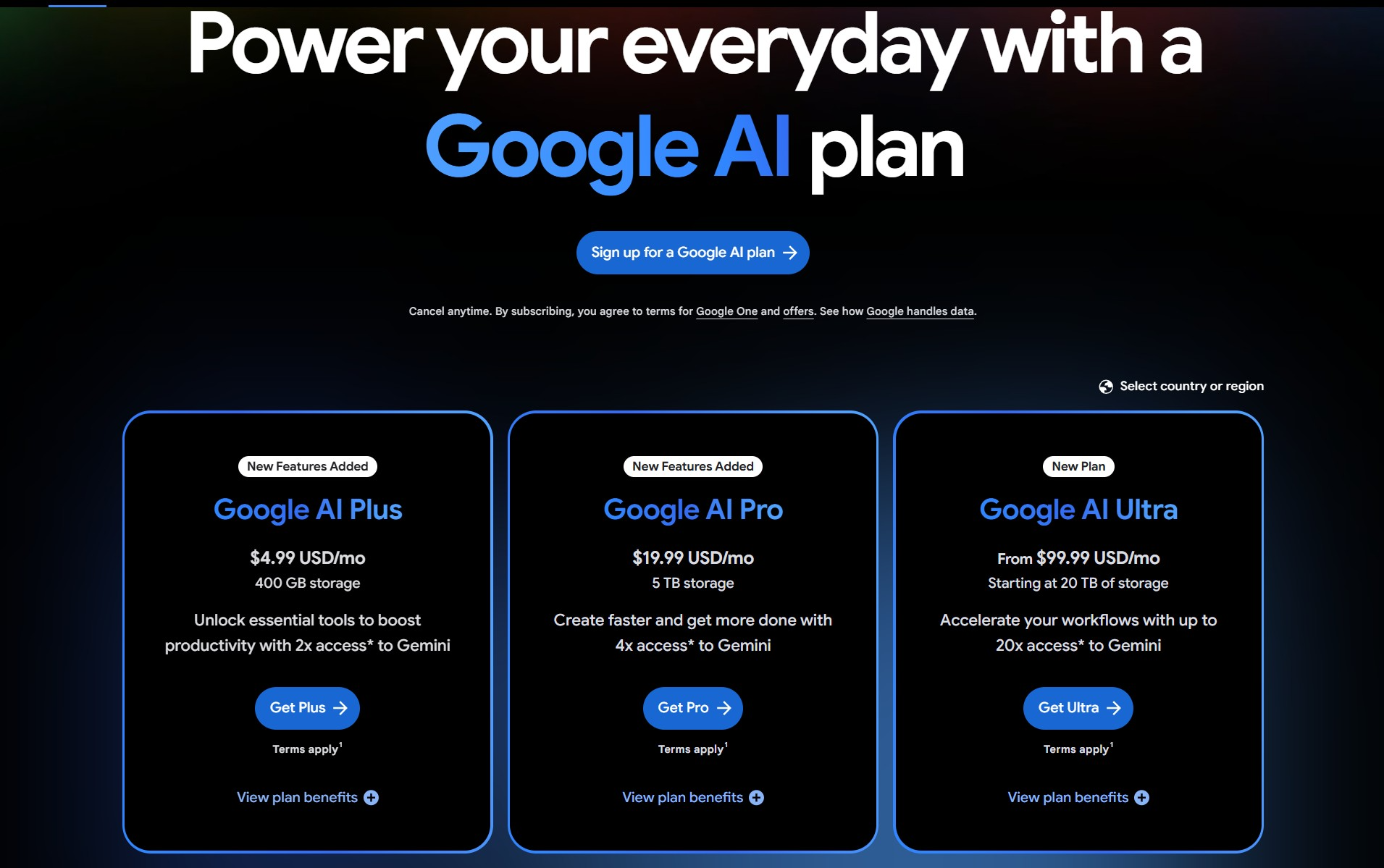
Subscriptions first, since that is what an ordinary user pays. The API table sits lower and matters only if you build on it.
| Plan | Claude | |
|---|---|---|
| Free | $0, Sonnet and Haiku | $0, reduced access vs paid |
| Entry paid | Pro $20/mo, about $17/mo on the annual plan ($200 upfront) | AI Plus $4.99/mo (400 GB storage); AI Pro $19.99/mo (annual $199.99) |
| Top tier | Max $100/mo (5x) up to $200/mo (20x), monthly only | AI Ultra $99.99/mo (5x) or $199.99/mo (20x) |
| Bundled extras | Claude Code | 5 TB storage, YouTube Premium Lite |
The extras are where people undercount. Once storage and streaming are included, the Gemini vs Claude gap at the $20 step is smaller than the headline numbers suggest, but only if you would otherwise pay for that storage or that streaming service.
API and per-token pricing, for developers only. Every figure is per million tokens and applies only if you call the API or automate at scale.
| Model | Input / Output per 1M tokens |
|---|---|
| Claude Fable 5.1 | $10 / $50 |
| Claude Opus 5.5 | $4 / $20 |
| Claude Sonnet 5.5 | $2 / $10 |
| Gemini 3.1 Pro | $2 / $12 (prompts up to 200K tokens; higher rates apply above 200K) |
| Gemini 3.1 Flash-Lite | $0.25 / $1.50 (text, image, and video input) |
These numbers cannot pick a consumer plan for you. A lower API price does not make a subscription better value for someone typing at a keyboard, and any source that jumps from an API figure to "so choose Gemini" is making a claim the data does not support. The per-token Gemini vs Claude difference is a developer's line item.
Anthropic's plan structure is on Claude's pricing page, the Google side is on Google One's AI plan page, and the API rates are on Google's Gemini API pricing doc. For the plan-by-plan walkthrough behind these numbers, Claude pricing explained goes deeper.
Keep One or Both? A 3-Question Decision Framework
Most people who land on a Gemini vs Claude comparison do not need both tools. They need to know which single one to start with. Answer these three questions in order.
| Your answer | What to do |
|---|---|
| Google is where your files and mail already live | Start with Google AI Pro. It costs less to enter and plugs straight into Docs and Drive. |
| Your main output is finished writing or code | Start with Claude Pro, and test it on your own drafts for two weeks first. |
| You do both, every week, at real volume | Keep both, but only if the time you save is worth $40 a month to you. |
The Gemini vs Claude overlap is bigger than the marketing suggests. Both read files, handle images, and hold long projects, and both have a browser and a phone app. Two subscriptions are justified only by two genuinely different jobs. If you are unsure whether even one paid plan earns its keep, is Claude free sets out what the free tiers actually cover.
5 Ways to Pay Less: Free, Single, Rotate, Official Family Sharing, Third-Party
The Gemini vs Claude cost question has five answers, and the order matters because the safe ones come first.
| # | Way | Who it fits | Limits and risk | Evidence |
|---|---|---|---|---|
| 1 | Free tiers | Low-frequency users | Claude free has no Opus or Fable; Gemini free access sits below its paid tiers | Vendor pages |
| 2 | One paid plan | You need only one tool | About $20/mo each; top tiers run $100 to $200/mo | Vendor pages |
| 3 | Rotating subscriptions | Seasonal need, and you accept switching | You cancel and renew by hand; projects and history move manually | Common practice, no vendor doc |
| 4 | Official family sharing | Eligible family members in the same household | Google allows eligible AI benefits to be shared with up to five family members; storage is shared, while AI usage limits vary by product. Some bundled benefits may be limited to the plan manager. Claude has no standard individual family plan. | Vendor pages |
| 5 | Third-party shared accounts and top-ups | The first four do not fit and you accept the risk | See below; no vendor guarantee | FamilyPro product pages |
Option 4 is one of the official ways to reduce the cost of eligible Google AI benefits. Google's family-sharing rules allow eligible benefits to be shared with up to five family members, subject to household and plan requirements. Storage is shared, while AI usage limits depend on the specific product. Some bundled services may remain limited to the plan manager, so check the terms for the exact plan and region before splitting the cost.
Option 5 needs care. A third-party shared account or top-up is a purchase channel, not an official plan, and it carries no vendor guarantee. It may help if you cannot pay the vendor directly with your available payment methods, but it remains a third-party arrangement rather than an official subscription. Check the account requirements, warranty terms, and access risks before ordering.
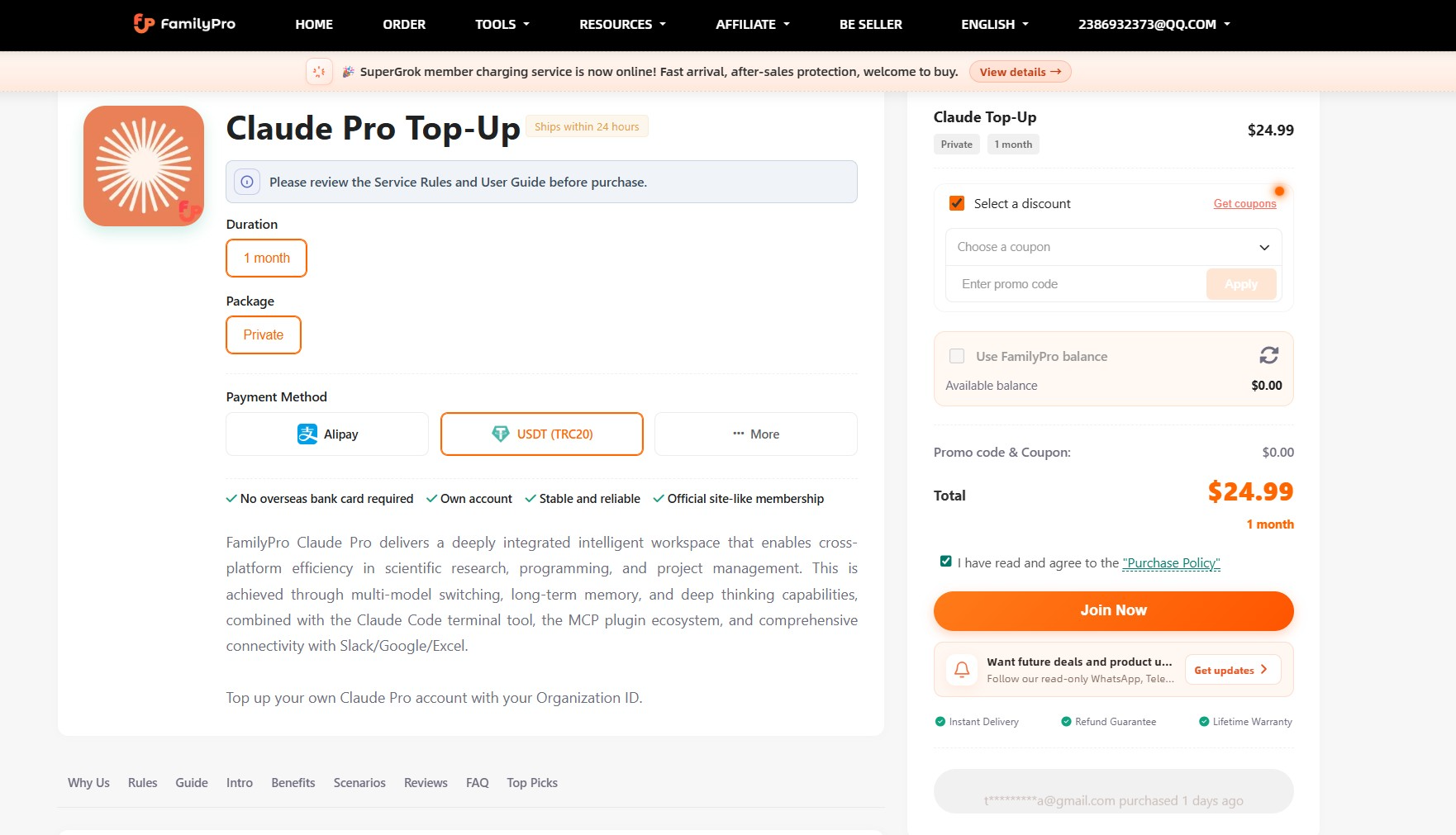
For Claude, FamilyPro lists a top-up at $24.99 a month that pays the vendor on your behalf while you keep your own account and login. Copy your Organization ID, or UUID, from Claude's account settings, paste it on the Claude top-up order page, and submit only when your current plan is near expiry or already expired, or the order may be rejected. The warranty covers an unexpected drop to the free tier and nothing else. A personal ban is not covered, and there is no renewal. Read the price as well: $24.99 a month sits above Claude's own annual rate of about $17 a month, so compare both sides first.
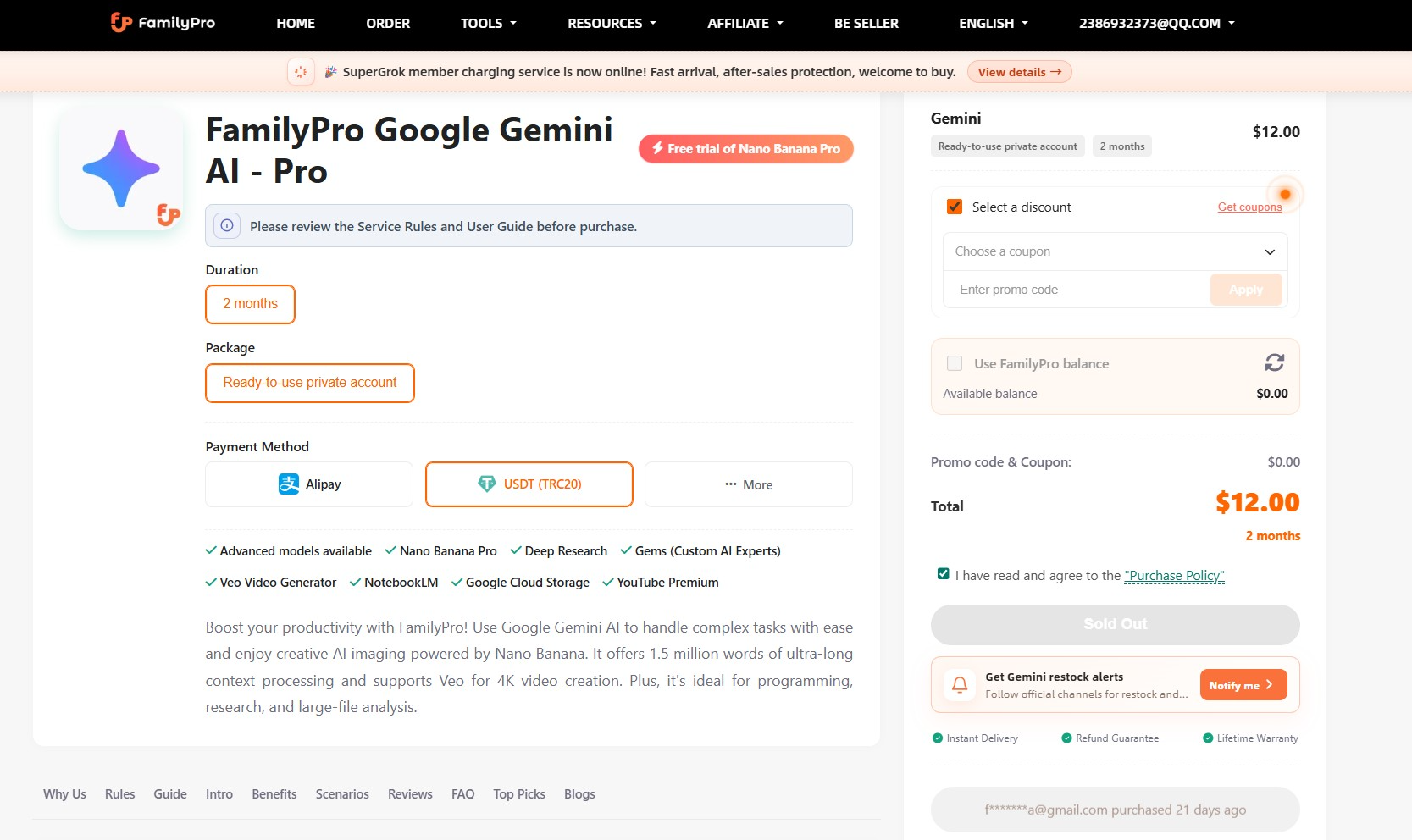
For the Gemini side, FamilyPro lists a prepaid Google AI Pro plan at $12 for one month. You order, read the account and password from your dashboard, log in at gemini.google.com, and bind your own phone number when the site asks. The rules ask for one fixed device and network, forbid sharing the credentials, and stop access at expiry with no renewal, so back up anything you keep there. Details are on the Gemini plan page.
Neither channel is cheaper or safer by default. Run today's numbers on both sides, then decide whether either is the right Gemini vs Claude shortcut for your budget.
FAQ: Gemini vs Claude Questions Answered
Is Claude Better Than Gemini in 2026?
No single answer holds. Published results for Claude Opus 4.7 and Gemini 3.1 Pro favour Claude on the specific software-engineering benchmarks cited above, but they are vendor-reported results for those model versions, not a definitive ranking of the latest releases. For everyday writing and research, the result depends on your prompts and habits, so test both tools on your own tasks rather than relying on a leaderboard alone.
Which Is Cheaper, Gemini or Claude?
On subscriptions, Google starts at $4.99 a month and Claude at $20. That Google entry plan carries less storage and lower access than Google's own top tier, so a lower starting price does not make it the cheaper Gemini vs Claude option for everyone. Match the tier to your use, not the number on the banner.
Which Is Better for Coding, Gemini or Claude?
Anthropic reported Opus 4.7 at 87.6 on SWE-bench Verified and 64.3 on SWE-bench Pro, compared with 80.6 and 54.2 for Gemini 3.1 Pro. These results apply to the specific versions tested and are not our own benchmark runs. They should not be treated as a definitive ranking of the latest models. Price and context-window limits should be compared separately using current model specifications.
Can I Use Both Without Paying Twice?
Partly. Google allows eligible AI benefits to be shared with up to five family members, subject to household, plan, and regional requirements. Storage is shared, while AI usage limits vary by product, and some bundled benefits may be limited to the plan manager. Claude has no standard individual family plan. Any third-party sharing arrangement carries separate risks.
Should I Cancel Claude if I Already Use Google Workspace?
Only if your writing and coding can move to Gemini without a quality drop you care about. Workspace users get more from the Gemini side out of the box. If prose is your main output, run your own two-week test before you cancel, because no public benchmark settles this Gemini vs Claude question for you.
Conclusion: Pick by Workflow, Not by Hype
The Gemini vs Claude choice is not about which model is smarter in the abstract. It is about which one fits the work you already do. Start free on both, give each one real tasks for a week, then pay for the single plan whose gap you actually felt. If budget is the blocker, work down the five options above, starting with eligible official Google family sharing where available, and treat any third-party route as a cost decision that carries additional risk. The only Gemini vs Claude test that counts is whether you still open the same one in week two.