
GPT-6 models explained: Astra, Sol, Luna and GPT-6.1 Sol
The GPT-6 family includes Astra, Sol, Luna and the newer GPT-6.1 Sol. For complex work in Codex, ChatGPT Work or the API, start by evaluating 6.1 Sol. Try Luna for classification and extraction at scale, and Astra for demanding reasoning or professional deliverables. The “GPT-6” option in regular ChatGPT Chat has a separate mapping; it does not automatically mean 6.1 Sol.
OpenAI launched Astra on September 3, Sol and Luna on September 22, and 6.1 Sol on September 29, 2026. The important changes from GPT-5.6 concern complex execution, reliability and cost, although user experiences vary. OpenAI API changelog
Official information and USD prices checked October 16, 2026. Official evaluations, community measurements and editorial recommendations are identified separately.
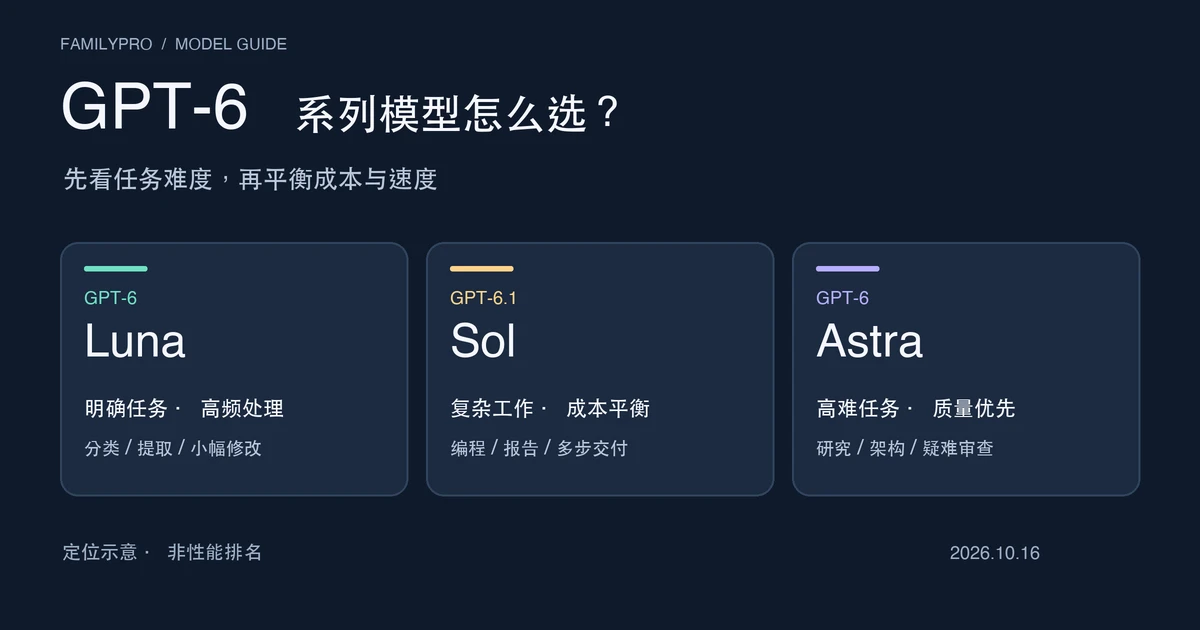
Editorial illustration of model positioning, not a product screenshot or benchmark.
Quick navigation
- Models
- Changes from GPT-5.6
- What is GPT-6.1 Sol?
- API prices
- ChatGPT subscriptions
- Choosing by task
- Community reviews and speed tests
- FAQ
Which GPT-6 models are available?
| Model | Positioning | Best starting use |
|---|---|---|
| GPT-6 Astra | Flagship | Research, hard reasoning, complex engineering |
| GPT-6 Sol | Original balanced model | Coding, tools, agent workflows |
| GPT-6.1 Sol | Updated balanced model | Complex coding and cost-sensitive agents |
| GPT-6 Luna | Lightweight and efficient | Batch processing, classification, extraction |
Astra prioritizes the highest quality on difficult work: large repositories, research, business reports, professional software and extended computer tasks. Its tool use and completion quality still depend on the tools and permissions an application provides. Its higher price makes it an expensive default for routine requests.
GPT-6 Sol was the initial balanced option for coding, tool use and agents. Its standard input and output rates are one fifth of Astra’s. Some experienced 5.6 Sol users nevertheless report worse completeness and execution stability on their workflows.
GPT-6.1 Sol, released a week later, targets complex coding, document understanding, computer use and factual accuracy at substantially lower cost than Astra. “Astra Lite” is a community nickname, not an official model. The cited announcement does not establish an architectural relationship or prove that 6.1 Sol is a compressed Astra.
Luna is the inexpensive, faster starting point for clearly specified work: classifying support tickets, extracting structured data, filtering information, simple code changes and routine automation. Identifying whether an email concerns a refund rarely requires frontier mathematical reasoning.
The API still exposes GPT-6 Sol, but new projects can evaluate 6.1 Sol first. GPT-5.6 had Sol, Terra and Luna tiers; the current GPT-6 catalog has no official Terra counterpart. 6.1 Sol occupies the practical middle position. OpenAI model catalog
GPT-6 versus GPT-5.6: what improved?
Coding and complex engineering
The following numbers are a snapshot from the Astra launch report, taking each model’s best result across reasoning settings. They are not comparisons at identical reasoning effort. Research/API evaluations can differ from production ChatGPT; we have not rerun them. GPT-6 Astra: release and evaluations
| Benchmark | GPT-5.6 Sol | GPT-6 Astra |
|---|---|---|
| Terminal-Bench 4.0 | 37.3% | 57.9% |
| DeepSWE v1.1 | 72.7% | 74.1% |
| FrontierCode 1.1 Main (score) | 47.5 | 53.3 |
| Database migration (internal) | 42.7% | 63.9% |
Astra gains 20.6 percentage points on Terminal-Bench, but only 1.4 points on DeepSWE. Improvement varies by evaluation; these scores cannot classify all programming tasks into categories of large and small gains. Test whether a model understands your repository, runs tests and produces mergeable changes, rather than measuring code generation speed alone.
Computer use
These results use the report’s OSWorld v2026.08.08 offline set and the no-tools ScreenSpot-Pro setting. OSWorld measures computer tasks, ScreenSpot measures visual targeting, and AutomationBench covers workflows across business tools. GPT-6 Astra: release and evaluations
| Benchmark | GPT-5.6 Sol | GPT-6 Astra |
|---|---|---|
| OSWorld 2.0 (offline, partial credit) | 65.7% | 72.6% |
| ScreenSpot-Pro | 76.9% | 92.7% |
| AutomationBench | 18.1% | 41.4% |
In the official OSWorld latency simulation, 5.6 Sol takes approximately 75 minutes per task at a 65.7% score; Astra takes about 40 minutes at 72.6%. That is roughly 47% less simulated time while improving the score. OSWorld uses partial credit here: the percentages are not the share of tasks completed perfectly. Neither the score nor the time saving guarantees the same result in your environment.
Science, factuality and authorized execution
In the Astra launch snapshot, Terminal-Bench Science 0.1 rises from 22.4% to 64.6%, and FrontierMath Tier 4 v2 from 83.0% to 97.6%. Later reports may update scores. These benchmarks do not establish an equivalent improvement across all research work or replace independent checks of methods, data and conclusions. GPT-6 Astra: release and evaluations
OpenAI reports roughly half as many factual errors for 6 Sol as its predecessor on a specially constructed difficult evaluation. For 6.1 Sol at low reasoning effort, responses containing errors fall from 11.4% to 7.7%: a 3.7 percentage-point decrease, or about 32% relatively. These samples were drawn from difficult conversations where users had flagged errors; they are not typical everyday error rates. GPT-6 Sol and Luna: release notes GPT-6.1 Sol: release and evaluations
Astra was also trained to follow authorization boundaries more accurately, reducing unauthorized extra actions, misleading execution reports and departures from the goal. This matters when an agent can access files, browsers and external systems; useful capability includes respecting the limits of its assignment. GPT-6 Astra: release and evaluations
Context during long tasks
The Astra announcement describes experimental Codex support for working notes and retrieval from previous context windows. This aims to reduce lost details during long debugging or refactoring. Check current client documentation for availability and activation; launch behavior is not a universal default. The series also improves prompt caching, potentially lowering repeated-context costs in agents. GPT-6 Astra: release and evaluations GPT-6 Sol and Luna: release notes
What is GPT-6.1 Sol, and how does it differ from 6 Sol?
OpenAI reports that 6.1 Sol exceeds 6 Sol’s best DeepSWE v1.1 score by 6.4 percentage points at lower reasoning effort and cost, and matches Astra at around one fifth of its task cost. On OSWorld 2.0 offline at Max, it comes within 2.1 percentage points of Astra at around one seventh of its task cost. Those ratios belong to specific evaluations and settings. Astra remains the recommendation for the hardest scientific problems. GPT-6.1 Sol: release and evaluations
Standard API input/output rates stay at $2/$10 per million tokens, while cached input reads drop from $0.20 for 6 Sol to $0.10 for 6.1 Sol. Repeated repository context, tool definitions and history can make this meaningful; an isolated short question may save little. Reduced token use in some complex tasks can lower the bill further.
Lower cost does not guarantee lower latency. Service mode, reasoning effort and load affect generation speed. Some users find 6.1 Sol much slower than 5.6 Sol. Evaluate background execution for long tasks and measure latency independently for interactive work.
6.1 Sol supports neither none nor minimal reasoning; its minimum is low. Compare Luna, which supports none, for simple tasks. Tool calling with 6.1 Sol requires the Responses API, so changing an old application’s model ID alone is not a complete migration. GPT-6.1 Sol API documentation
GPT-6 API prices and a cost example
These are Standard text rates in USD per million tokens for requests with no more than 272K input tokens. OpenAI API pricing
| Model | Input | Cached input | Output |
|---|---|---|---|
| GPT-5.6 Sol | $4.00 | $0.40 | $20.00 |
| GPT-6 Astra | $10.00 | $1.00 | $50.00 |
| GPT-6 Sol | $2.00 | $0.20 | $10.00 |
| GPT-6.1 Sol | $2.00 | $0.10 | $10.00 |
| GPT-6 Luna | $0.10 | $0.01 | $0.50 |
Astra’s standard input/output prices are 2.5 times 5.6 Sol’s; both 6 Sol variants cost half as much as 5.6 Sol. For equal uncached input/output counts, Luna costs one hundredth as much as Astra. The 5.6 Sol rates are promotional, stated to last at least until November 21, 2026; recheck afterward. GPT-5.6 Sol API documentation
Suppose a support system handles 1,000 requests monthly, each using 2,000 input tokens and 500 billed output tokens, including reasoning. That totals 2 million input and 0.5 million output tokens. With no caching, tools, retries or extra fees:
| Model | Illustrative monthly API cost |
|---|---|
| GPT-6 Astra | $45.00 |
| GPT-6.1 Sol | $9.00 |
| GPT-6 Luna | $0.45 |
For 6.1 Sol: 2 × $2 + 0.5 × $10 = $9. This is fixed-usage arithmetic, not a measured average. If 500 tokens means only the visible answer, add internal reasoning tokens, billed at output rates. Reasoning token billing
Luna may suffice for ticket categories, order-number extraction and JSON. Stronger models may reduce human correction costs for complex disputes, evidence analysis or multi-step decisions. Compare cost per successfully completed task, not unit prices alone.
Billing details that change the calculation
- The main models offer around 1.05 million tokens of context and up to 128K output. 5.6 Sol already had this capacity.
- Above 272K input tokens, long-context rates apply to the entire request: input/cache-related rates double and output costs 1.5 times the standard rate.
- Cache reads differ from writes: 6.1 Sol reads cost $0.10 per million tokens; standard writes cost $2.50.
- Batch/Flex generally cost 50% less than Standard, with queueing, throughput or latency tradeoffs. Fast generally costs twice Standard; 6.1 Sol API Ultrafast costs six times Standard. Model eligibility varies, and price multipliers are not speed guarantees. Supported regional processing may add 10%.
ChatGPT subscription prices and model access
Subscriptions provide plan-based usage; API billing is separate. Plus does not include $20 of API credit. The following are official USD monthly prices, subject to local checkout, taxes and availability. Regular Chat and Work/Codex have different entitlements.
| Plan | USD/month | GPT-6 access |
|---|---|---|
| Free | $0 | Chat: 5.6 Luna rollout; Codex desktop: separate 6 Luna rollout |
| Go | $8 | Chat: 5.6 Luna; Codex desktop: separate 6 Luna rollout |
| Plus | $20 | 6 Sol in Chat; Astra and 6.1 Sol in Work/Codex |
| Pro 100 | $100 | GPT-6 Pro and higher work allowance |
| Pro 200 | $200 | Higher GPT-6 Pro, Work and Codex allowances |
| Pro 500 | $500 | Highest usage tier; Ultrafast access |
Free/Go access to 6 Luna in the Codex desktop app is subject to rollout; regular Chat uses 5.6 Luna. Enterprise and education plans have their own licensing rules. GPT-6 and other models in ChatGPT ChatGPT Work and Codex pricing ChatGPT Pro tiers
What does “GPT-6” in ChatGPT mean?
On eligible paid Chat plans, the thinking levels map as follows:
| Thinking level | Underlying model |
|---|---|
| Instant | GPT-6 Sol |
| Medium | GPT-6 Sol |
| High | GPT-6 Sol |
| Extra High | GPT-6 Sol |
| Pro | GPT-6 Pro, powered by GPT-6 Astra |
Plus normally offers Instant, Medium and High, excluding Extra High and Pro Chat. Higher plans offer additional levels; check your account. 6.1 Sol is not currently a separate regular Chat choice, but is available through Work, Codex and the API. Not seeing it in Chat does not establish its availability elsewhere. GPT-6 Pro also has a separate allowance; a Pro subscription does not mean unlimited Astra.
Pro 500 Ultrafast consumes included allowance at eight times the model’s standard rate. Purchased Credits after the allowance are charged at six times the standard Credit rate. Decide whether you need volume, capability or lower latency before upgrading. See Codex usage limits and resets and ChatGPT Go versus Plus. GPT-6 and other models in ChatGPT ChatGPT Pro tiers
Choosing a GPT-6 model by task
These are evaluation starting points based on the official selection guide, not guaranteed configurations. Regular Chat uses its displayed thinking levels; Work/Codex and the API have their own supported settings. OpenAI model selection guide
| Task | Model to evaluate | Reasoning effort |
|---|---|---|
| Classification, tagging, extraction | GPT-6 Luna | None / Low |
| High-volume support and simple text | GPT-6 Luna | Low / Medium |
| Everyday ChatGPT conversations | GPT-6 Sol | Instant |
| Long articles, analysis, planning | GPT-6 Sol | Medium / High |
| Routine coding and bug fixes | GPT-6.1 Sol | Medium |
| Multi-file refactoring and code review | GPT-6.1 Sol | High / XHigh |
| Large engineering and computer tasks | GPT-6 Astra | Medium → High / Max |
| Difficult science and specialist reasoning | GPT-6 Astra | Medium / High / Max |
| Scheduled batch automation | GPT-6 Luna → Sol | Low / Medium |
More reasoning can increase verification, tokens and elapsed time without helping clearly bounded simple work.
Route tasks by complexity
Start routine work on Luna. Escalate failed rule checks, conflicting information or known multi-step tasks to 6.1 Sol. Use business rules, output validation and sampling rather than the model’s self-reported confidence. Reserve Astra for difficult cases where failures are costly. A support system might classify tickets on Luna, analyze contractual disputes on Sol and use Astra to assist with the hardest cases, with humans deciding the outcome.
Measure the complete cost
Task cost includes model calls, tools, retries and human correction. A cheap model requiring five attempts may cost more than a flagship completing the work once. For coding, include test results, mergeability, change scope and review time.
Use asynchronous work and caching where appropriate
Repository scans, weekly reports, document processing and long analyses can run in the background. Independent parallel tasks reduce human waiting, but do not automatically reduce the bill. Interactive products may benefit more from Luna, lower reasoning effort or a faster service tier.
Keep reusable system prompts, tool definitions and repository instructions in stable cacheable prefixes. Check actual usage for cache hits; repeated content is not automatically all billed at cached rates. Caching also does not replace removing stale or irrelevant context.
Community reviews: coding quality, cost and speed
The following traceable Reddit and Hacker News examples are not a random sample or a measure of global opinion. They highlight conflicting experiences worth testing in your own workflow.
Astra: professional ability, quota costs and interruptions
Reddit user imadade reports completing business and theoretical problems that previously required repeated guidance, with concise communication and follow-up questions mainly when needed. Reddit: early GPT-6 Astra experiences
On Hacker News, one user comparing identical prompts against 5.6 Sol found Astra retrieved more relevant sources and better learning materials. Another praised synthesis and natural language but disliked the price and quota consumption. A desktop-automation report described repeated stops requiring requests to continue. Tools, prompts, planning and allowances can all affect the outcome. Hacker News: GPT-6 Astra discussion
GPT-6 Sol: some users prefer 5.6
Jarr11 on r/OpenAI found 6 Sol less thorough and complete on complex work, while Astra felt too expensive. Some commenters returned to 5.6 Sol. These are workflow experiences, not controlled general evaluations; reasoning settings, tools and execution environments may differ. Benchmark gains do not promise equal gains in every existing workflow. Reddit: GPT-6 Sol versus GPT-5.6 Sol
GPT-6.1 Sol: 24 real coding tasks
bisonbear2 tested 24 merged changes from one Go/TypeScript repository, running each model once per task at Medium:
| Relative result versus GPT-6 Sol | GPT-6.1 Sol tasks |
|---|---|
| Wins | 9 |
| Ties | 10 |
| Losses | 5 |
6.1 Sol had a small overall scoring advantage and typical task costs around half those of 6 Sol. The author observed cheaper cached input and fewer tokens, but larger changes requiring more review. Completion times were not meaningfully different.
Five losses are relative comparisons, not five failed tasks, so they do not establish a task success rate. This is one repository with one run per model/task, and scoring includes a model judge. The author also develops the Stet evaluation tool. Do not generalize the results to all coding work. Reddit: 24 coding tasks, GPT-6.1 Sol versus GPT-6 Sol
A community generation-speed test
Hot_Season8992 measured all models at XHigh. Rates below are output tokens per second:
| Model | Normal (tokens/s) | Fast (tokens/s) |
|---|---|---|
| GPT-5.6 Sol | 102.6 | 168.1 |
| GPT-6 Sol | 77.0 | 117.4 |
| GPT-6 Astra | 44.4 | 65.4 |
| GPT-6.1 Sol | 22.3 | 64.2 |
| GPT-6 Luna | 184.7 | 188.5 |
In this test, Normal 6.1 Sol generated at roughly one fifth of 5.6 Sol’s speed. Fast improved its own throughput substantially but remained below 5.6 Sol Fast. These are one user’s measurements at a particular time and configuration, not official guarantees. Accounts, requests and server load can change results. Reddit: model generation speed comparison
Token throughput also differs from end-to-end completion: fewer tool calls or retries can offset slower generation. On Hacker News, conception considered the waiting cost too high and favored faster alternatives for some work; another developer found lower reasoning effort tolerable. Hacker News: GPT-6.1 Sol latency discussion
Conflicting task-quality reports
Upper-Animator-5067 described a Medium-effort jungle-game project that remained incomplete and unplayable after correction requests. Reddit: a disappointing GPT-6.1 Sol game project In contrast, Impossible-Sand5012 reported reliable parallel Max-effort work with low quota use, without complete comparative usage logs. Reddit: positive GPT-6.1 Sol parallel-work experience
Maintaining a large repository, creating a playable game and interactive coding have different requirements. These reports suggest testing Astra’s quality against quota cost, retaining 5.6 as a baseline where 6 Sol disappoints, and evaluating 6.1 Sol’s cost and latency separately. People with unusually positive or negative experiences are more likely to post; many comparisons do not control versions, reasoning, load or tools.
How to evaluate GPT-6 on your own work
Start with 30–50 recent real tasks spanning easy, medium and difficult cases. This is a practical starting suggestion, not a statistically representative sample. Keep task descriptions, data and tool permissions consistent across Luna, 6.1 Sol and Astra.
Record actual completion quality, total cost including cache/tools/retries, elapsed time to a usable result and human intervention. For complex coding, begin with 6.1 Sol Medium and compare Low and High. Test Luna first for frequent standardized tasks; add Astra where measured quality justifies it.
GPT-6 FAQ
Which GPT-6 model is strongest?
OpenAI positions Astra for the hardest work. Choose by success rate, total cost and elapsed time: test 6.1 Sol for complex everyday coding and Luna for classification or extraction.
Is GPT-6.1 Sol cheaper than GPT-6 Sol?
Both charge $2 input and $10 output per million tokens at Standard rates. Cached reads fall from $0.20 to $0.10. Actual task cost depends on reasoning, cache hits, tools and rework; it is not universally half the price.
Can ChatGPT Plus use GPT-6.1 Sol?
Official documentation lists it for Plus in Work and Codex. Regular Chat has a separate GPT-6 mapping. Rollout, client version and account access still matter.
Is GPT-6.1 Sol always slower than 5.6 Sol?
No universal conclusion follows from the cited community test. Compare complete task time under matching reasoning settings and service modes, not output tokens per second alone.
Should every GPT-5.6 workflow migrate?
Keep 5.6 as a baseline and test the same tasks. Migrate when quality, cost or waiting time improves enough to justify it; applications can also route among Luna, Sol and Astra.
References
- OpenAI API changelog
- OpenAI model catalog
- GPT-6 Astra: release and evaluations
- GPT-6.1 Sol: release and evaluations
- GPT-6 Sol and Luna: release notes
- GPT-6.1 Sol API documentation
- GPT-5.6 Sol API documentation
- Reasoning token billing
- OpenAI API pricing
- GPT-6 and other models in ChatGPT
- ChatGPT Work and Codex pricing
- ChatGPT Pro tiers
- OpenAI model selection guide
- Reddit: early GPT-6 Astra experiences
- Hacker News: GPT-6 Astra discussion
- Reddit: GPT-6 Sol versus GPT-5.6 Sol
- Reddit: 24 coding tasks, GPT-6.1 Sol versus GPT-6 Sol
- Reddit: model generation speed comparison
- Hacker News: GPT-6.1 Sol latency discussion
- Reddit: a disappointing GPT-6.1 Sol game project
- Reddit: positive GPT-6.1 Sol parallel-work experience
Official data and prices checked October 16, 2026. Community figures are reported by the original authors and were not independently reproduced here.