
GPT Access Denied? 2026 Fix for Error 1020 & More
When GPT Access Denied pops up, most people assume the worst: their account is gone. I did the same the first time it happened to me. In almost every case I have reproduced since, though, the block had nothing to do with the account. It was the network, the VPN, or the region. 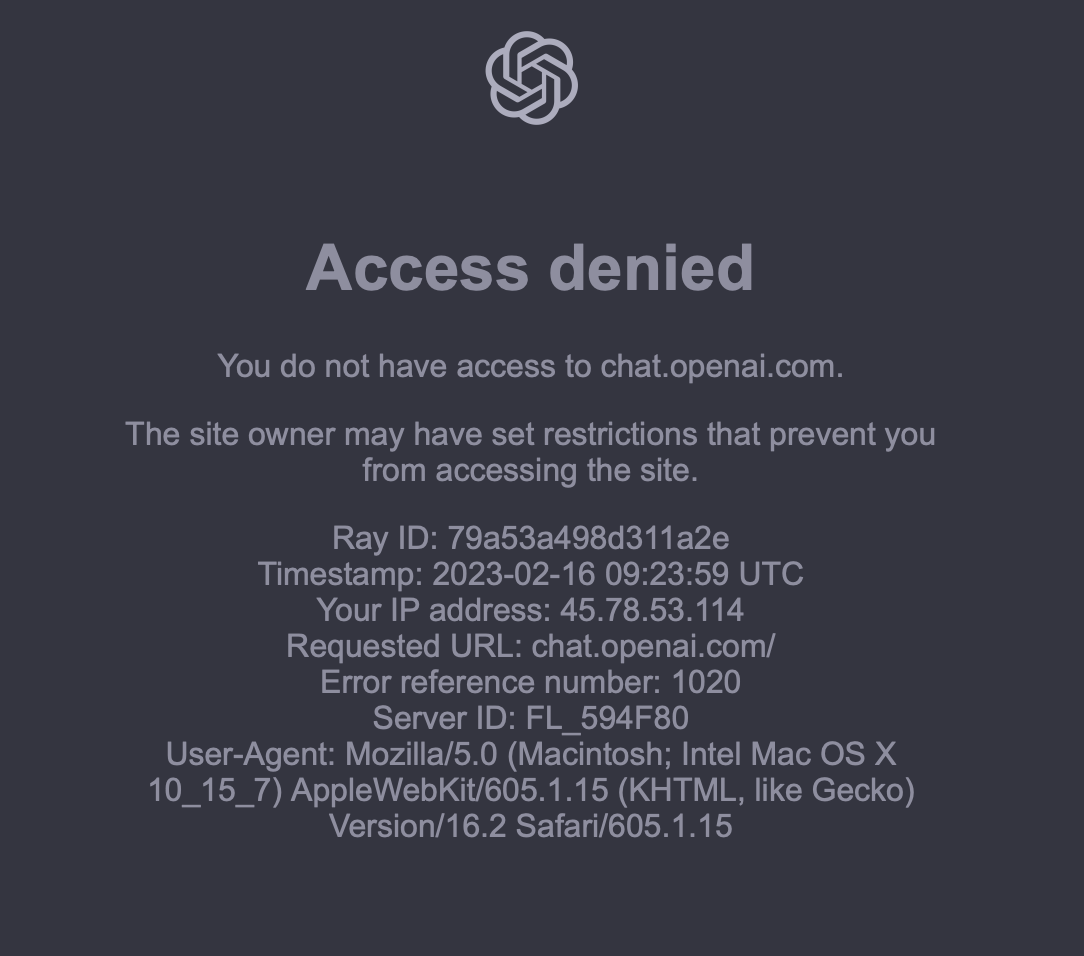 GPT Access Denied is annoying precisely because it is vague. Here is the straight answer. It is a broad access error, not one single problem. In some cases it comes from an IP or security block such as Cloudflare Error 1020. In others the cause is your VPN, region, browser session, account, or even a temporary OpenAI service issue. When the block is network-related, it usually means your IP or location looks suspicious, not that you broke a rule. I tested each fix below on my own Chrome browser and iPhone, and the connection came back the moment I dropped the VPN or moved to mobile data.
If you just want back in: open OpenAI's status page, turn off any VPN or proxy, switch from Wi-Fi to your phone's hotspot, then clear your GPT cookies and sign in again. The rest of this guide shows how to tell whether the problem is really your account, and what to do when the simple fixes do not stick.
What "GPT Access Denied" means (and why it happens)
"Access Denied" is a block message, not a single error code. In many cases the block traces back to Cloudflare, the network OpenAI sits behind. Cloudflare can step in when a request looks risky, and it may return a refusal before GPT ever sees it. That is only one path, though, not the whole story.
People mix this up with Error 1020, and the two are related but not the same. Think of "Access Denied" as the symptom and Error 1020 as one possible diagnosis. Error 1020 is one specific Cloudflare refusal tied to IP or security rules. GPT Access Denied is the broader, user-facing message that can come from several causes:
- Your IP or VPN endpoint is flagged (most common).
- Your region is not on OpenAI's supported list.
- A session or cookie went stale and the auth check failed.
- Your subscription lapsed or the account hit a limit.
- OpenAI's own service is having a bad few minutes.
So when you see GPT Access Denied, the useful question is not "am I banned?" but "which of these is it?" The next section gives you a fast way to narrow it down.
Is it your account or just a blocked IP?
This is the part most guides skip, and it is the part that actually saves you time. The trick is to watch what changes the error.
| What you see | Most likely cause | What to try |
|---|---|---|
| Works on mobile data but not on Wi-Fi | IP or network block | Restart the router or switch networks |
| 1020 appears the instant you load the page | IP or security block | Turn off the VPN or proxy |
| The same account fails on every device | Account or authentication issue | Look for any account or sign-in notice from OpenAI |
| Other accounts work on the same device | Account-specific problem | Sign in with a different account to confirm |
| Only one country cannot reach it | Regional restriction | Check OpenAI's supported regions |
| Login works but GPT will not load | Session or browser issue | Clear cookies and sign in again |
I once burned twenty minutes convinced I had been banned, then tethered my laptop to my phone and the chat loaded in two seconds. The problem was my home ISP's IP, not my account. If a different network fixes it, your account is fine.
When the issue does follow the account, head to our guide on deactivated GPT accounts and the unusual activity notice some users see before a block.
How to fix GPT Access Denied (step by step)
Work these in order. Each step removes one likely cause, so you do not waste time on fixes you do not need. Following the order below clears GPT Access Denied faster than trying fixes at random.
- Check OpenAI's status page at status.openai.com. If the API or chat service is down, nothing you do locally will help, and you just wait it out.
- Turn off your VPN or proxy. Datacenter IPs get blocked hard, and this alone clears the error for a lot of people.
- Switch networks. Move from Wi-Fi to mobile hotspot, or try a different Wi-Fi. This isolates an IP block from an account problem.
- Clear your GPT cookies and sign in again. Stale sessions throw a denial even when the account is healthy. I do this in Chrome settings under "Cookies and site data" for chatgpt.com.
- Check your region. OpenAI does not serve every country (see help.openai.com for the supported list). If you recently traveled or changed your VPN location, verify that you are connecting from a region where GPT is supported.
- Confirm the problem follows your account. Try signing in on a second account on the same device. If the second account works, the first one needs attention, not the network.
- Contact support only after the steps above. You will give them far better info if you already know it is network vs account. This is the fastest reliable GPT Access Denied fix I have found.
Does Access Denied happen more on shared accounts?
Short answer: a shared account does not cause GPT Access Denied by itself. But it does make the cause harder to pin down, because the activity, sessions, and login patterns are spread across several people.
When GPT Access Denied shows up on a shared login, start with the network checks above. Most GPT Access Denied reports on shared logins still trace back to the network, not the seat. If three people share one login, a block on one device might trace back to someone else's VPN or a session left open elsewhere. That is annoying, not dangerous, and it is not a ban. The trade-off is the usual one with shared plans: you pay less, but memory is account-level and the history is mixed with other users.
If you are already weighing whether to use a shared or personal setup, the trade-off is mostly about cost and account isolation, not whether one is guaranteed to avoid Access Denied.
- If paying OpenAI directly is awkward from where you are (no international card, regional blocks, or currency friction), a personal top-up plan lets FamilyPro handle the payment for you. You still get an isolated account with your own memory and no one else's sessions in the way.
- A shared GPT plan costs less and works fine for most people.
Our fuller write-up on getting a shared GPT account covers the setup and the gotchas.
Still seeing Access Denied? It may be a different error
Sometimes what looks like GPT Access Denied is a different message wearing a similar face. If GPT Access Denied returns right after you fixed the network, look at the table below. Telling them apart changes the fix.
| Error | What it usually means |
|---|---|
| 1020 | Security or IP restriction at Cloudflare |
| 401 | Authentication problem, usually a stale or invalid token |
| Access Denied | Network, region, or account block (the broad one) |
| Unsupported country | Your region is not served by OpenAI |
| Subscription issue | Billing lapsed, so the account lost access |
If you keep hitting a 401 after clearing cookies, the token is the issue, not the IP. If the message names a country, it is regional, and a VPN into a blocked region will only make it worse. When billing is the cause, check your plan and payment status in OpenAI settings, and the account deactivated guide covers the harder cases.
GPT Access Denied on mobile and file stream
A note for phone users: GPT Access Denied on mobile often follows the same network rules as desktop. The quickest mobile fix is to drop the VPN and switch from Wi-Fi to cellular data.
The "File Stream Access Denied" message is a different animal. It shows up inside the app when you try to attach or read a file, and it points at the in-app file permission or a stale session, not the general login block. Do not rerun the whole network checklist for it. Close the app, sign out and back in, and check that the file type is one GPT accepts. If the main chat works but only file actions fail, the account is fine and the problem is local to that action.
For the broader "something went wrong" class of mobile errors, see our GPT something went wrong guide.
FAQ: GPT Access Denied questions answered
Q1: What does GPT Access Denied mean? It means OpenAI's edge network refused your request before GPT processed it. The usual reasons are a flagged IP, a VPN, an unsupported region, a stale session, or a lapsed subscription. It is a block message, not a single error code, so the fix depends on which cause you are hitting.
Q2: Why am I getting GPT Error 1020? Error 1020 is Cloudflare refusing the connection on IP or security grounds. It fires most often when you are on a VPN, a datacenter proxy, or an IP your ISP recycled from a blocked range. Turning off the VPN or switching networks clears it in most cases I have seen.
Q3: Why does GPT say Access Denied when I use a VPN? Because OpenAI blocks many VPN and proxy exit nodes to cut abuse. Your account is not the problem; the IP the VPN hands you is. Disconnect the VPN, or pick an endpoint in a supported region, and the chat should load. A normal mobile or home connection usually works.
Q4: Why does GPT work on mobile data but not Wi-Fi? That pattern points at your Wi-Fi IP, not your account. Home and office IPs get flagged, especially after an outage or a range change. Tether to your phone or restart the router, and if the chat loads on cellular, you have your answer. That strongly suggests the problem is with the Wi-Fi network or IP rather than the account.
Q5: Can a shared GPT account cause Access Denied? Not by itself. A shared login does not trigger a block, but it makes the cause harder to find because several people share the session and history. If one user runs a VPN or leaves a session open, another can see the denial. Isolation, not a ban, is the usual fix.
Q6: Is GPT Access Denied the same as Error 401? No. Access Denied is the broad message covering network, region, or account blocks. Error 401 is specifically an authentication failure, usually a stale or invalid token. If clearing cookies and signing in again removes a 401, the issue was your session, not your IP or account standing.
Q7: Why does GPT Access Denied keep coming back? Recurring denials usually mean the underlying cause was never removed. A VPN that auto-reconnects, a router IP that stays flagged, or a session that keeps expiring will bring it back. Fix the source (stay off the blocked VPN, use a clean network, sign in fresh) instead of repeating the same steps.
Q8: How do I fix GPT Access Denied on Android? Open the GPT app, sign out, then clear the app cache in your phone settings. Turn off any VPN and switch from Wi-Fi to mobile data. If the site loads in your phone browser but not the app, reinstall the app. The account is almost certainly fine if the browser version works.
Conclusion: Get back into GPT in 2026
In many cases, getting past GPT Access Denied starts with the network rather than the account. A flagged IP, a VPN, or a regional restriction is often the trigger. Run the network checks first, confirm whether the problem follows your account, and only then look at billing or support.
If you are choosing between a shared and a personal setup, the difference is mostly cost and account isolation, not a guarantee against Access Denied. A personal top-up plan is handy when paying OpenAI directly is awkward from your region. FamilyPro handles the payment for you, and you still get one isolated account with your own memory and no one else's sessions in the way. If cost matters more and sharing is fine, the shared plan does the job. Either way, you are back to chatting in a few minutes.